Important Georgia Excess Tax Sale Funds Case: Home Equity Credit Series 2021 v. Patrick Labat

Facts

In a well-reasoned and clearly articulated opinion dated April 17, 2025, the Georgia Court of Appeals clarified the rights of parties claiming excess funds following a tax sale. In Home Equity Credit Series 2021 v. Patrick Labat, a tax sale held on February 1, 2022, generated $438,598.95 in excess funds. The property was later redeemed on behalf of the owner, Nelson, by mortgage servicer NewRez (acting through its agent, CoreLogic) for $528,000.

The Fulton County Sheriff subsequently filed an interpleader action to determine the rightful recipients of the excess funds. Claims were filed by: NewRez, seeking $276,763.71 to satisfy a mortgage payoff as servicer for Freddie Mac; Georgia Housing and Finance Authority (GHFA), claiming $6,833.22 based on a subordinate security deed; and Home Equity Credit, claiming entitlement to all remaining funds based on an assignment of rights from Nelson.

At a hearing,  trial court awarded: $276,763.71 to NewRez, $6,833.22 to GHFA, $151,014.46 to another lienholder, $3,987.56 to the Sheriff for costs. Home Equity Credit received nothing and appealed.

Key Legal Issue

The central legal question on appeal was whether holders of security deeds are entitled to excess tax sale funds under OCGA § 48-4-5, or whether their claims are limited to interests in real property only, and therefore excluded.

Home Equity Credit contended that NewRez and GHFA were ineligible to receive any excess funds as their interests were limited to real estate, not personal property. They relied primarily on two cases: DLT List, LLC v. MM7VEN, 301 Ga. 131 (2017), which held that excess tax sale funds are personal property and cannot be claimed by parties whose interests attach only to the real estate; and Jackson v. Wellington & Assoc., 389 F. Supp. 3d 1199 (N.D. Ga. 2019), where a federal court went further, suggesting that security deed holders are not entitled to such funds.

Court of Appeals Ruling

The Court distinguished Jackson as non-binding federal precedent and emphasized the plain language of OCGA § 48-4-5(a)-(b), which requires notice to “record owner[s] of each security deed” and directs the superior court to distribute excess funds “to the owner or owners as their interests appear.”

Additionally, citing OCGA § 44-14-60, the Court noted that holders of security deeds retain actual legal title and are considered “owners” under Georgia law. The Court therefore found that the Georgia Legislature clearly intended for such parties to receive excess funds in line with their lien priorities.

Conclusion

The Georgia Court of Appeals affirmed the trial court’s distribution of excess funds and held that security deed holders are eligible recipients under OCGA § 48-4-5. The Court declined to follow contrary federal authority and reaffirmed the rights of lienholders to claim excess funds based on their recorded interests.

Call Us

If you have questions, do not hesitate to call us at 404-382-9994.

Excess Tax Sale Funds in Georgia: A Quick Review

Property

In Georgia, properties can be auctioned if the owner fails to pay property taxes. When a property is sold at a tax sale for more than the amount owed in taxes, the remaining funds are considered excess funds. These funds are typically held by the county tax commissioner’s office or the sheriff. The Georgia statute that addresses excess tax sale funds is OCGA § 48-4-5.

How long do you have?

Excess funds will be maintained for five years from the date of sale under OCGA § 48-4-5(c) before being turned over to the Georgia Department of Revenue, Unclaimed Property Division.

Who is Entitled to Excess Funds?

Generally, those who may be entitled to claim excess funds include:

  • The property owner at the time of the tax sale: If the property owner can prove ownership and has not relinquished their rights, they may be entitled to the excess funds.
  • Lien holders: Mortgage companies or other lien holders with a recorded interest in the property at the time of the tax sale may also be entitled to claim the funds.
  • Other interested parties: In some cases, other parties with a legitimate interest in the property may be able to claim excess funds.

Excess tax sale funds are paid first to lienholders with a recorded interest on the day of the tax sale (in the order the interests were recorded) and then to the property owner at the time of the tax sale.

Claim Process

Claiming excess tax sale funds can be a bureaucratic and frustrating process. It involves providing documentation to prove ownership or interest in the property and filing a claim with the county tax commissioner’s office. The specific requirements and procedures vary by county.

Claiming excess tax sale funds can be challenging for several reasons:

  • Documentation requirements: Proving ownership or interest in a property can be difficult, especially if the property has changed hands multiple times or records are incomplete.
  • Bureaucratic hurdles: Like many government agencies or large corporations, filing a claim can be time-consuming and frustrating, with unnecessary bureaucratic obstacles.

If you are entitled to excess tax sale funds, here are some tips:

  • Act promptly: Research the time limits for filing claims in your county and act quickly.
  • Gather documentation: Collect relevant documents, such as deeds, mortgages, and property tax records.
  • Consult an attorney: An attorney can help you navigate the legal process and protect your rights.

Would you like to know more about a specific aspect of excess tax sale funds in Georgia, such as the time limits for filing claims or the documentation required? Please call us at 404-382-9994; we’ll happily answer any questions.  

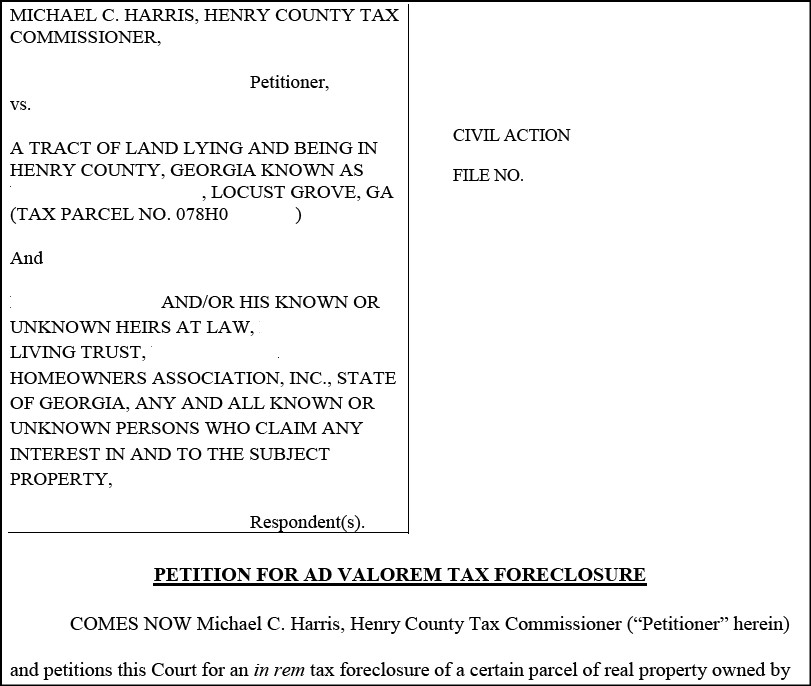
Judicial In Rem Tax Sales

Judicial in Rem Tax Sales

Recently, we have seen more judicial tax sales in Georgia. This type of sale is much different than a non-judicial tax sale. OCGA § 48-4-75. Both the procedures and the deadlines differ.

When a taxpayer fails to property taxes, a county may file a judicial-in-rem tax sale. OCGA § 48-4-78. When the county employs this type of tax sale, it files a “Petition” in the superior court. The Petition is against the property itself and anyone with an interest in the property, including the owner.

Once the county files the Petition, the county gives notice to the interested parties. OCGA § 48-4-78. The county posts the property with copies of the summons and Petition, notice to interested parties, and notice of hearing. The county also sends the documents by regular and certified mail to all interested parties. Lastly, the county publishes a legal notice in the county newspaper alerting the public. The notice runs for two weeks).

Following notice, the court holds a hearing. Any interested party has the right to be heard and to contest the allegations in the Petition at the hearing. If the superior court determines that the information in the Petition is accurate and that the county gave proper notice, the court will order the county to sell the property at an auction. OCGA § 48-4-79.

The county then advertises the sale of the property in the county’s legal newspaper for four weeks. The advertisement will show the owner’s name, a description of the property to be sold, and the amount of the tax due OCGA §§ 9-13-140-142.

Before judicial tax sale auction, an interested party may redeem the property by paying the redemption amount to the county tax commissioner. If an interested party pays the redemption amount, the county dismisses the Petition. OCGA § 48-4-80.

One of the main differences between judicial and non-judicial tax sales is that a judicial tax sale allows only 60 days to redeem (buy back the property). In a non-judicial tax sale, the owner has at least one year to redeem. OCGA § 48-4-81.

The other major difference is judicial tax sales vest title absolutely into the purchaser. In theory, this eliminates the need for post-sale barment procedures and quiet title actions. There is little case law to provide guidance, but we expect the courts to consider these issues in the future.

Tax Deed Redemption: Tricks of the Trade

Tax Deed Redemption Tricks of the Trade

Redemption Process

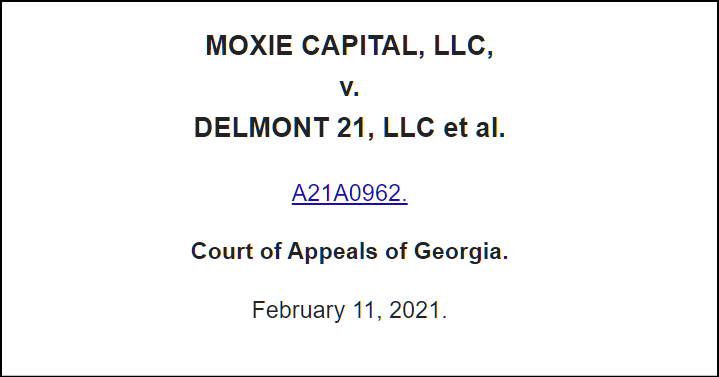
A new Georgia appellate case, Moxie Capital v. Delmont 21 (2021), has been released that every tax deed purchaser, investor, and property owner should know about. The case involves how to redeem a property following a tax sale.

OCGA § 48-4-40 says the property owner or an interest holder in the property may redeem a property following a tax sale. Redemption must occur within a twelve-month window and after a notice of right to redeem has been provided. OCGA § 48-4-42 states how much a redeeming party must pay to redeem. Importantly, the funds required to redeem “shall be paid in lawful money of the United States.”

Redemption Dispute

In Moxie Capital, an investor attempted to redeem a property. For various reasons, the attempted redemption occurred on the last day of the redemption period. The investor contacted the tax deed holder for a payoff. There were conflicting versions of what happened from there. The investor said the tax deed holder did not cooperate; while the tax deed holder argued he had no obligation to cooperate.

What the parties don’t dispute is that the investor timely delivered a personal check to the tax deed holder. The investor claimed that certified funds were not available because the banks had closed by the time he found out the details of where to deliver the redemption amount. On the next day, the tax deed holder returned the personal check to the investor. And claimed that the investor’s right to redeem had expired.

Naturally, this went to court. While somewhat complicated, ultimately, the investor lost. And the tax deed purchaser got the property. The Georgia Court of Appeals ruled that to redeem, funds must be in the form of cash or certified check. The Court cited OCGA § 48-4-42, which says funds must be “paid in lawful money of the United States.” Although no Georgia court has clearly defined “lawful money,” the Georgia Court of Appeals reasoned that a personal check is a promise to pay. Thus, the Court of Appeals did not consider the investor’s personal check to be a payment.

The Court of Appeals also suggested that a tax deed purchaser has no obligation to act in “good faith” when responding to a party trying to redeem.

Don’t Wait Until the Last Minute – Call Us

Moxie Capital is consistent with other Georgia cases that apply redemption statutes strictly. Some would say harshly. Whether you agree or disagree with the outcome will depend on which side of the ledger you’re on.

Regardless of if you are a tax deed purchaser or a homeowner, we will be glad to represent you to get you through the process safely.

Call Us at 404-382-9991 to speak with an attorney regarding your options!

Another Georgia Excess Tax Sale Funds Case

Republic Title Co. v. Freeport Title & Guar., Inc., A19A0274 (May. 29, 2019) concerns entitlement to excess funds remaining following a tax sale pursuant to OCGA § 48-3-3. We’ve discussed this in previous blogs. There isn’t much new here but the case does reinforce some tax deed principles of interest. In this case, the property owner at the time of the tax sale sought to collect excess tax sale proceeds following the tax sale. Also following the tax sale, a security deed holder on the property similarly sought the excess tax funds.

The owner filed a lawsuit seeking the excess tax funds, and, in the same lawsuit, sought to quiet the security deed holder’s lien as a cloud on title. The argument was the loan had matured for more than seven years and therefore wasn’t enforceable at the time of the tax sale. In Georgia, under O.C.G.A. § 44-14-80, title to real property conveyed to secure a debt or debts revert to the grantor the expiration of seven years from the maturity of the debt or debts or the maturity of the last installment thereof as stated or fixed in the record of the conveyance (this is the general rule).

Following the recommendation issued by a special master appointed in the case, the trial court ruled in favor of the owner; awarding the owner the excess tax funds and quieting title against the security deed holder. The Georgia Court of Appeals agreed. The Georgia Court of Appeals rejected the security deed holder’s argument that the special master didn’t have authority to issue a ruling on excess funds. And the security deed holder’s argument that the property owner lacked standing to bring a quiet title was likewise disregarded. Although the quiet title was filed by the owner after the tax sale, it was filed within the time period in which the owner had a right to redeem the property. Thus, the owner’s right to redeem was enough to give the owner standing to quiet title against the security deed holder.

If you have any questions regarding tax deeds, please call us at 404-382-9994.

Does a Foreclosure Sale Determine Fair Market Value in Georgia?

The answer is a resounding yes according to an interesting case that came out recently. SeeDekalb County Board Of Tax Assessors v. Astor Atl, LLC, A19A0516 (April 1, 2019). In that case, the Georgia Court of Appeals rejected DeKalb County’s argument that it could assess property taxes in an amount higher than the price paid for the same property at a foreclosure sale.

Dekalb County argued that a foreclosure sale does not qualify under as an arm’s length, bona fide sale, and that it had appraised the property in conformity with its rules using the sales comparison approach.

In deciding the case, the Georgia Court of Appeals referenced O.C.G.A. § 48-5-2(3), which provides a limitation on the maximum allowable fair market value. Under that statute, “the transaction amount of the most recent arm’s length, bona fide sale in any year shall be the maximum allowable fair market value for the next taxable year.”

The decision concluded by holding that foreclosure sales can be arm’s length, bona fide sales. Moreover, the fact that the sale may not bring in the true market value of the property does not require a different rule; the fact that the sale results in a financial loss is not relevant.

The court noted that foreclosure sales are distinct from tax sales. While foreclosures are considered arm’s length, bona fide sales, tax sales are considered “forced sales” because owner retains a right of redemption, so the tax deed purchaser does not obtain proper title until the redemption period has run.

While this isn’t super helpful in the current market with surging property values, it would definitely help investors should the real estate market turn south down the road. Something to keep in mind.

Please call us at 404-382-9994 for real estate related questions.

Can a tax commissioner apply excess funds to post-tax sale property taxes?

Iglesia Del Dios Vivo Columna Y Apoyo De La Verdad La Luz Del Mundo, Inc. v. Downing, 321 Ga. App. 778 (2013) addressed this issue, and the answer, quite simply, is NO. (Bonus points for being able to say the plaintiff’s name in that case three times fast.)

The guiding statute is O.C.G.A. § 48-4-5, which provides that any excess funds existing “after paying taxes, costs, and all expenses of a sale made by the tax commissioner” shall be distributed “to the owner or owners as their interests appear in the order of priority in which their interests exist.”

So, while a tax commissioner is authorized to apply excess funds to satisfy outstanding property taxes owed by the delinquent taxpayer that accrued before the tax sale, it can’t do so after the tax sale. This reasoning for this is that the tax deed purchaser, not the delinquent taxpayer, is liable for post-tax sale property taxes.

What about a situation in which post-tax sale property taxes accrue before the tax deed purchaser has barred the right of redemption? In this situation, the delinquent taxpayer still has possession and the tax deed purchaser doesn’t have full title. Is the delinquent taxpayer jointly liable with the tax deed purchaser? According to the Downing case, the answer is no.  Only the tax deed purchaser is liable for post-tax sale property taxes; this is regardless of whether the right to redeem has been barred.

Who Gets Excess Tax Sale Funds in Georgia?

Revisiting a previous post, under Georgia law, a tax commissioner holds excess funds generated by a tax sale in a fiduciary capacity, and the disbursement of those funds is governed by OCGA § 48-4-5. But, after a tax sale, if there are excess funds after paying taxes, costs, and all expenses of a sale, who gets these funds? The answer, generally, is distribution of excess tax funds is based on the right to the funds at the time of the tax sale.

When there are excess tax funds, the officer selling the property shall give written notice of the excess funds to the record owner of the property at the time of the tax sale and to the record owner of each security deed affecting the property and to all other parties having any recorded equity interest or claim in such property at the time of the tax sale. Such notice shall be sent by first-class mail within 30 days after the tax sale, and shall contain a description of the land sold, the date sold, the name and address of the tax sale purchaser, the total sale price, and the amount of excess funds collected and held by the tax commissioner, tax collector, sheriff, or other officer. The notice shall state that the excess funds are available for distribution to the owner or owners as their interests appear in the order of priority in which their interests exist.

If there is a dispute regarding who is entitled to the excess tax funds, an interpleader is filed and the excess funds are distributed by the superior court to the intended parties, including the owner, as their interests appear and in the order of priority in which their interests exist.

Some issues that come up in regard to distribution of excess tax funds is whether a “super-lien” obtained via a redemption gives the redeeming party a right to claim the excess funds. The answer is no because a super-lien places a lien on the real property but not on the excess tax sale funds.

Another issue is when additional taxes come due after the tax sale—is the tax commissioner allowed to use the excess funds for taxes due after the tax sale? The answer is no because the tax deed purchaser is the party responsible for paying property taxes after the tax sale. The remedy for the tax purchaser is to add taxes paid to the redemption price.

And, finally, what happens if the owner of the property sells the property after the tax sale? Is the new owner entitled to the excess tax sale funds? The answer is no. Georgia law considers excess tax sale funds to be personal property; thus, these funds do not attach to the real estate. One exception is if the sales agreement contains language assigning the excess tax sale funds, then the person who sold the property loses their right to the excess funds.  Georgia Lien Services, Inc. v. Barrett, 272 Ga. App. 656 (2005).

Georgia Tax Deed Purchasers Are Responsible for Paying Association Dues

Under Georgia law, a tax deed purchaser is obligated to pay homeowners’ association assessments that come due after the tax sale. See Croft v. Fairfield Plantation Property Owners Assn., 276 Ga. App. 311, 314 (2005). This includes the period before the purchaser can foreclose on the right of redemption. Georgia courts have held that a tax deed purchaser acquires sufficient title to trigger automatic membership in the association. The rationale is that assessments and fees paid to a homeowners’ associations benefit a tax deed purchaser.

The good news for tax deed holders is that Georgia courts allow tax deed holders to include condominium association assessments paid as part of the redemption price. Harvest Assets, LLC v. Northlake Manor Condo. Assn., 340 Ga. App. 237 (2017).