Tax Deed Redemption: Tricks of the Trade

Tax Deed Redemption Tricks of the Trade

Redemption Process

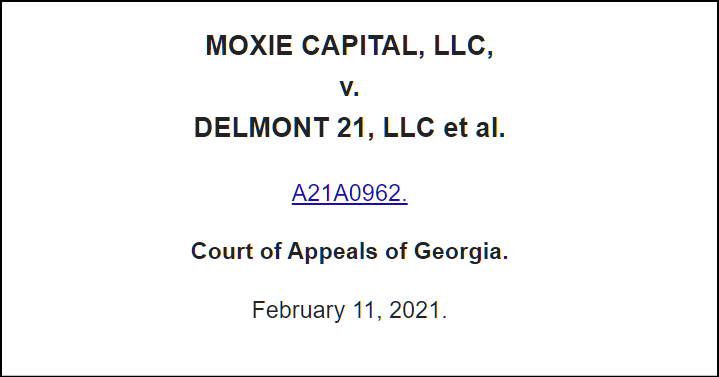
A new Georgia appellate case, Moxie Capital v. Delmont 21 (2021), has been released that every tax deed purchaser, investor, and property owner should know about. The case involves how to redeem a property following a tax sale.

OCGA § 48-4-40 says the property owner or an interest holder in the property may redeem a property following a tax sale. Redemption must occur within a twelve-month window and after a notice of right to redeem has been provided. OCGA § 48-4-42 states how much a redeeming party must pay to redeem. Importantly, the funds required to redeem “shall be paid in lawful money of the United States.”

Redemption Dispute

In Moxie Capital, an investor attempted to redeem a property. For various reasons, the attempted redemption occurred on the last day of the redemption period. The investor contacted the tax deed holder for a payoff. There were conflicting versions of what happened from there. The investor said the tax deed holder did not cooperate; while the tax deed holder argued he had no obligation to cooperate.

What the parties don’t dispute is that the investor timely delivered a personal check to the tax deed holder. The investor claimed that certified funds were not available because the banks had closed by the time he found out the details of where to deliver the redemption amount. On the next day, the tax deed holder returned the personal check to the investor. And claimed that the investor’s right to redeem had expired.

Naturally, this went to court. While somewhat complicated, ultimately, the investor lost. And the tax deed purchaser got the property. The Georgia Court of Appeals ruled that to redeem, funds must be in the form of cash or certified check. The Court cited OCGA § 48-4-42, which says funds must be “paid in lawful money of the United States.” Although no Georgia court has clearly defined “lawful money,” the Georgia Court of Appeals reasoned that a personal check is a promise to pay. Thus, the Court of Appeals did not consider the investor’s personal check to be a payment.

The Court of Appeals also suggested that a tax deed purchaser has no obligation to act in “good faith” when responding to a party trying to redeem.

Don’t Wait Until the Last Minute – Call Us

Moxie Capital is consistent with other Georgia cases that apply redemption statutes strictly. Some would say harshly. Whether you agree or disagree with the outcome will depend on which side of the ledger you’re on.

Regardless of if you are a tax deed purchaser or a homeowner, we will be glad to represent you to get you through the process safely.

Call Us at 404-382-9991 to speak with an attorney regarding your options!

TRANSFER OF TAX FIFA’S IN GEORGIA

TRANSFER OF TAX FIFA’S IN GEORGIA

Property taxes in Georgia are due towards the end of the year. For example, in Fulton County, 2021 taxes were due by November 15, 2021. When property taxes are not paid, the county’s taxing authority issues a fifa. A fifa acts as a lien against the property and is recorded on the county’s real estate records. The taxing authority must issue a 30-day notice to property owners before filing the fifa. The lien remains on the county’s public records until the taxpayer pays the taxes.

The most dramatic event that happens after filing a fifa is that the taxing authority may present the tax lien to the sheriff. The sheriff will use the fifa as a basis to auction the property to pay the taxes. This process is known as a tax sale.

To get taxes paid, taxing authorities in Georgia often sell their fifa’s to third-party investors. FIG and Investa are two companies that purchase tax liens.

For a taxpayer, a transfer of a tax fifa is confusing because the third party pays the county. The taxes are then owed to third-party, not the county. Thus, the county will show the taxes as paid, but the taxes are still owed.

Under Georgia law, OCGA § 48-3-19, the third-party purchasing the lien must send notice by first-class mail to the taxpayer within 60 days. In theory, this is to notify the taxpayer of whom to pay the taxes to. However, our office has had reports from taxpayers claiming they didn’t get any notice. Like the taxing authority, the third party can take the fifa to the sheriff and ask to auction the property to pay off the fifa.

If taxes are unpaid, you need to act as quickly as possible to pay the taxes to the correct party before there is a tax sale. Please call us at 404-382-9994 if you find yourself in this situation.

Georgia: Injury to Real Estate

Georgia Injury to Real Estate

          The Georgia legislature has passed several statutes to protect landowners against interference with and injury to their real estate. The starting point is that enjoyment of private property is an “absolute right” of every citizen. Any interference with such enjoyment creates a tort (wrongful act or an infringement of a right resulting in civil legal liability). OCGA § 51-9-1.

            To the extent a person wrongfully deprives a landowner of possession of their property, the landowner can seek to recover possession and sue for damages for such injury to real estate. OCGA § 51-9-2. Similarly, if any person wrongfully interferes with a landowner’s possession, the landowner can seek damages. OCGA § 51-9-3.

            Likewise, if a person wrongfully enters the landowner’s land or property without permission, a landowner to bring an action for trespass for injury to real estate. OCGA § 51-9-4. Trespass applies to persons wrongfully on land and applies to such things as improperly placed improvements or causing flooding on a landowners’ property. Anyone or anything that comes onto someone’s land due to wrongful conduct of another person can be a trespass. Suppose two persons claim possession of the same land. In that case, the person with title to the land is deeming to be rightfully in possession. In contrast, the other person is deemed to be a trespasser. OCGA § 51-9-5.

            Regarding damages for trespass, such damages are limited to damages incurred up until an action is filed. OCGA § 51-9-6. Damages that occur after filing a lawsuit create a new cause of action.

            Regarding streams (more formally called non-navigable watercourses), such landowners are entitled to the natural and usual flow of the stream across their property. If a person wrongfully diverts the stream from its natural and usual flow or lessens the value of the stream, this is considered trespass. OCGA § 51-9-7. The same applies to underground streams and interference of the space below and above the land’s surface. OCGA §§ 51-9-8 and 51-9-9. The last grounds for bringing a trespass action is if a person wrongfully interferes with a landowner’s right of way. OCGA § 51-9-10.

            Finally, a landowner claims damages if any person wrongfully puts the landowners’ title to the property in question. OCGA § 51-9-11. When this happens, it is known as slander of title. An example would be if a person files a fraudulent deed on the public record and this deed causes the rightful owner’s title to be clouded. Clouded means that there is a possible issue with title. Wrongfully clouding title is considered an injury to real estate in Georgia.

            If you are a landowner and your enjoyment of your land is being interfered with or violated, please call us at 404-382-9994 to discuss your options.

Expiration of security deeds in Georgia

Expiration of security deeds in Georgia

Do real estate mortgages expire after a certain amount of time? In Georgia, a security deed is the document that secures a loan on real estate. OCGA § 44-14-80 states that security deeds expire seven years after the maturity of the last installment date stated in the security deed. OCGA § 44-14-80 further says if the security deed contains no maturity date, the security deed expires after seven years.

When a security deed expires, title automatically “reverts” (goes back) to the borrower. In other words, if sufficient time has passed, the security deed is automatically cancelled. Most importantly, after the security deed is cancelled, the lender loses its lien against the property and cannot foreclose.

These concepts were the focus of a recent Georgia Court of Appeals case: Freeport Title & Guaranty. In that case, the parties disagreed whether a security deed had expired. The security deed had a space to insert a due date, but, whoever drafted the security deed, left the space blank. One party argued that the security had expired after seven years because the security deed had no maturity date. The other party responded that omitting the due date was a mistake. Instead, that party argued that the borrower and the lender had intended to include a due date.

The Georgia Court of Appeals found that the security deed had not expired after seven years. Even though the parties had not included specific date in the security deed. The court reasoned that the parties had intended to include a fixed date. In addition, the Court of Appeals ruled that the promissory note, which did include a due date, could be used to “fill in the blanks.”

The takeaway, when evaluating whether a security deed in Georgia has expired, is to consider the promissory note and the security deed . However, unlike security deeds, lenders do not record promissory notes on the public record. So getting a copy to review may be challenging.

If you have a question about a security deed, please call us at 404-382-9994 to discuss.

Adverse Possession and Property Disputes Clarified

The Georgia Court of Appeals issued a decision that provides some guidance to the often-unintuitive law known as adverse possession. In Houston v. James, A20A1689 (February 3, 2021), three siblings involved in a property dispute sued each other over a 28-acre parcel owned by their deceased father. One sibling lived on and took care of the 28 acres for more than 20 years. But his father left most of the property to the other two siblings. The sibling left out argued he owned the 28 acres by adverse possession. He claimed he had had publicly, continuously, uninterruptedly, and peaceably possessed the property for more than 20 years. His two siblings disagreed, arguing that the possession was without a “claim of right.”

To be adverse, possession must be for more than 20 years and must be public, continuous, exclusive, uninterrupted, peaceable, accompanied by a claim of right, and not originate in fraud. OCGA § 44-5-161(a). Also, and quite importantly, the party adversely possessing must have a “claim of right” to the property.

A claim of right means the possessor claims the property as his own. Under Georgia law, a claim of right, or adverse possession, will be presumed from the assertion of dominion, particularly where the possessor has made valuable improvements. See Childs v. Sammons, 272 Ga. 737, 739 (2) (534 SE2d 409) (2000). Georgia courts have held that there does not need to be direct evidence of the state of mind of the possessor concerning claim of title; however, there must be evidence of some claim of title in the sense that the possessor claims the property as his own. Walker v. Sapelo Island Heritage Authority, 285 Ga. 194, 674 S.E.2d 925 (2009).

In Houston, the Court of Appeals concluded that a jury must decide whether the sibling claiming the property by adverse possession did so with a claim of right. If you have a property dispute concerning adverse possession, please call us at 404-382-9994 to discuss your options.

Easements by Adverse Possession or Prescription

Georgia law allows a party to obtain a private way, also known as an easement, over the land of another through a process known as prescription (also sometimes called adverse possession). See OCGA Section 49-4-40 et seq. This requires seven years of uninterrupted use through improved lands. To show prescription, however, the party seeking an easement must show (1) uninterrupted use of the alleged private way, (2) that the private way is no more than twenty feet wide, (3) that they have kept the private way in repair, (4) and that the use was public, continuous, exclusive, peaceable, and accompanied by a claim of right. Finally, the use of the alleged easement must be adverse. This means that there cannot be adverse possession if the owner gives permission to use the property.

To obtain an easement over another’s land, the party seeking an easement must prove each of the above elements. All things being equal, the courts will favor the property owner over the party claiming an easement. This makes sense. Obtaining a legal right to go over someone else’s property should not be easy. On the other hand, a property owner has some responsibility to know how his or her property is being used by another and to prevent unauthorized use.

A recent Georgia Court of Appeals case decided this issue. In Wilkes 581 Farms, LLC v. McAvoy, A20A1225 (September 18, 2020), a party claimed an easement over a road belonging to another party. The court ruled against an easement over the road because the property owner had permitted the party claiming the easement to use the road. Thus, the claim was not “adverse.” In other words, if a property owner gives permission, there cannot be adverse possession or prescription.

Secondarily, the court ruled that the party seeking an easement lost because he could not show that the use of the road was exclusive. Instead, the evidence showed that others used the road. Finally, the court ruled that the alleged use was not adverse because the party claiming the easement had not notified the other property owner that he was claiming an ownership interest in the property owner’s property. The court explained that merely using a road for seven years is not enough to create adverse use. Instead, the party claiming an easement must make repairs or take other action to notify the property owner that someone else was claiming an ownership interest in his land.

If you have an easement question or dispute, please call us at 404-382-9994.

Georgia easements: Do you know what a bridle path is?

This issue came before the Georgia Court of Appeals. See Doxey v. Crissey, et al, A20A0443 (June 26, 2020). For those of you who do not know (the author included), a bridle path is “a trail for horseback riding.” The American Heritage Dictionary, 5th ed. (2020). See also Merriam-Webster Online Dictionary (2020) (bridle path is “a trail suitable for horseback riding”).

This case involved the enforceability of an easement originally intended as a bridle path, which the owner of the easement wanted to convert to a walking path. The case highlights two important principles related to real estate easements:

(1) To interpret the scope of an easement, the rules of contract construction apply; this is a question of law for the court. The cardinal rule of construction is to ascertain the parties’ intent. Here, the Court of Appeals found that the term “bridle path” has only one meaning, which is a trail for horseback riding. Thus, per the terms of the easement, the only allowed use under the easement was to ride a horse.

(2) As is typical in the law, there is an exception to the above rule. This occurs when use of the easement changes over time, so long as the change is not so substantial as to cause unreasonable damage to the servient estate or unreasonably interfere with its enjoyment. The servient estate is the property that granted or give the easement. This rule applies even without the consent of the servient estate. So, if the easement became a walking trail over time, and the change did not harm the party who granted the easement, then the easement converts to a walking path.

If you have any questions regarding an easement, please call us at 404-382-9991.

In Georgia, can a security interest in real estate expire?

Yes. A security interest in real estate expires (in other words, become unenforceable) seven years after expiration of the maturity of the debt. Or, if the language in the security deed contains an affirmative statement with the intent of establishing a perpetual security interest, then the expiration date is the later of (a) seven years from the maturity of the debt or (b) 20 years from the date of the conveyance. See O.C.G.A. § 44-14-80(a).

If a security deed expires based the above paragraph, the property reverts back to the borrower. This means the lender loses its security interest in the property and cannot foreclose.

An additional consideration is what happens if the loan is extended. O.C.G.A. § 44-14-80(b) answers this: as long as the loan is extended before the seven or 20 years—and, importantly, the extension is recorded on the public record—then the security interest is also extended by seven or 20 years (depending on the language in the security deed).

The import of recording an extension was the subject of a recent Georgia appellate decision. Bell v. Freeport Title & Guaranty, A20A0133 (May 1, 2020). In Bell, the loan and security went into default in 2007. However, the borrower signed two extensions. These extensions were never recorded on the public record. The lender foreclosed on the loan in 2015. The Georgia of Court of Appeals ruled that because the two extensions were not recorded, the lender’s security interest expired in 2014. Thus, the reversion of the property back to the borrower in 2014 voided the 2015 foreclosure.

Although mentioned in a footnote, Bell makes an important point, which is the grantee (here, the lender) has the duty to record its deed. Reidling v. Holcomb, 225 Ga. App. 229, 230-231 (1997). By failing to record the extensions, the lender had no one to blame but itself.

Please call Gomez & Golomb at 404-382-9994 if you have any questions about title to your property.

The Actual Tax Sale in Georgia

As a general rule, tax sales are held on the first Tuesday of the month. However, not every county has a tax sale every month. Generally, the tax sales are conducted between the hours of 10 am and 4 pm  on the steps of the county courthouse. If the first Tuesday of the month falls on a legal holiday, the sale is held the next day, Wednesday.

The opening bid for a particular property is the amount of tax due, plus penalties, interest, fi. fa. cost, levy cost, administrative levy fee, certified mail cost, advertising cost, and tax deed recording fees. The property is sold to the highest bidder.

Immediately following the conclusion of the tax sale all purchasers must pay in full the amount bid at the auction. Payment must be in the form of cash, certified check, or cashier’s check. Normally, the purchaser to sign a statement attesting to the fact that certain property was purchased for a certain price. After all payments are processed, the count will provide a Tax Deed and the Real Estate Transfer Tax form.

According to O.C.G.A. § 9-13-170, any person who becomes the purchaser of any real or personal property at any sale made at public outcry who fails or refuses to comply with the terms of the sale when requested to do so, shall be liable for the amount of the purchase money. It shall be the county’s option either to proceed against the purchaser for the full amount of the purchase money or to resell the real or personal property and then proceed against the first purchaser for any deficiency arising from the sale.

Investa Services of GA, LLC: Tax Sale Case

Anyone who deals with excess tax sale funds or tax deeds in Georgia knows that Investa and/or affiliated entities play a significant role with regard to tax sales. Plaintiffs filed a class action against, among others, Investa. In this lawsuit, Investa was accused of improperly levying on tax executions for delinquent property taxes. The initial tax assessments were later reduced via a property tax appeal.

The trial court dismissed the lawsuit and Investa appealed. See B.C. Grand, LLC v. Investa Services of GA, LLC, A19A1297 (GA Ct of App, October 29, 2019). On appeal, the court ruled in favor of Investa et al., finding that B.C. Grand “failed to allege that the [Tax] Commissioner cancelled the tax executions or that they are void as a matter of law based on the post-issuance reduction in the tax assessment.” Because B.C. Grand failed to pay the taxes at issue while pursuing its appeal of the assessment. Instead, it waited to receive a refund (which it did receive), the full amounts owed remained valid. B.C. Grand also failed to plead the executions were void as a matter of law. So Investa was authorized to levy the executions at the full purchase price amount. Chalk one up for Investa.