
Private Ways in Georgia Require Seven Years of Adverse Use

David Adams, Carly Adams

Private ways in Georgia are a type of easement that permit individuals to travel to and from their property and places of business. These ways cannot be wider than 20 feet, and the person claiming the private way is responsible for keeping it open and in good condition. This information is based on OCGA 44-9-40.

Thus, if you use a path through someone’s land for seven years straight, you may have the right to use it even if it’s not yours. This is called a private way by prescription, based on OCGA § 44-9-1. If the owner of the land obstructs your path, you can take them to court under OCGA § 44-9-59(a) to have the obstruction removed. However, if the owner gave you permission to use the path , you cannot acquire the right to use the path by prescription. The owner must be informed that you are making a hostile claim to their property and must be given actual notice of your adverse use. See Douglas v. Knox, 232 Ga. App. 551, 552 (2) (1998).

If your neighbor gives you permission to use their driveway, it’s important to remember that they have the right to revoke that permission at any time. In legal terms, this means that using your neighbor’s driveway with permission does not create a private way. A recent court case, Pineda v. Lewis (__ Ga. App. __, October 4, 2023, A23A0909), reaffirmed this principle.

To create an private way, you must give your neighbor notice that your use is adverse. This is true even if you make repairs to the driveway with your neighbor’s consent.

The bottom line is that traveling over a neighbor’s property with permission does not create a private way by prescription. If you have questions regarding your property rights concerning a neighbor, please call us at 404-382-9994 to discuss.


Easements and the Atlanta Beltline

Eastside Trail in Atlanta GA

A recent legal case regarding the Atlanta Beltline provides insightful reading for those interested in easements. In 2017, the Ansley Walk Condominium Association sued the Atlanta Development Authority, also known as Invest Atlanta, claiming ownership of three properties adjacent to the Beltline.

The case is complex, as the Norfolk Southern Railway Company initially operated the properties as a railway. However, in 2004, Norfolk relinquished its interests in the properties, which then became part of the Beltline. At the time of the transfer, Norfolk reserved an easement to cross over the properties.

In 2017, Norfolk signed an agreement to terminate its easement rights over the properties. However, the agreement was vague, so Norfolk signed a corrective agreement in 2020 to address the issue. Ansley Walk sued, alleging that when Norfolk relinquished its easement rights, Ansley Walk gained unrestricted ownership of the properties.

Ansley Walk claimed damages for inverse condemnation, trespass, attorneys’ fees, and litigation expenses. Both parties filed cross-motions for summary judgment, meaning they each sought a ruling in their favor without a trial. A summary judgment aims to expedite litigation and avoid the expense of a jury trial. However, a summary judgment can only be granted when there are “no genuine issues as to any material fact and that the moving party is entitled to a judgment as a matter of law” OCGA § 9-11-56(c); Pfeiffer v. Ga. Dept. of Transp., 275 Ga. 827, 828 (2002).

After considering the arguments and the law, the trial court granted summary judgment to the Beltline and denied summary judgment to Ansley Walk. This means that, for now, the Beltline has won the case. However, Ansley Walk plans to appeal the decision and ask the Georgia Court of Appeals to review the trial court’s ruling.

In granting summary judgment, the trial court found that Ansley Walk failed to prove ownership of the three properties and that the 2020 corrective agreement properly canceled Norfolk’s easement rights. As a result, the Norfolk agreements about the easements did not transfer any property rights to Ansley Walk.

Although this case’s factual scenario is unlikely in most easement disputes, it is still an interesting example of how such disputes never go out of fashion. If you have a dispute regarding an easement, please contact us at 404-382-9994 to discuss your legal rights.

Quiet Title: Cancelling an Expired Security Deed

Cancelling an Expired Security Deed in Georgia

Expiration of Security Deeds in Georgia

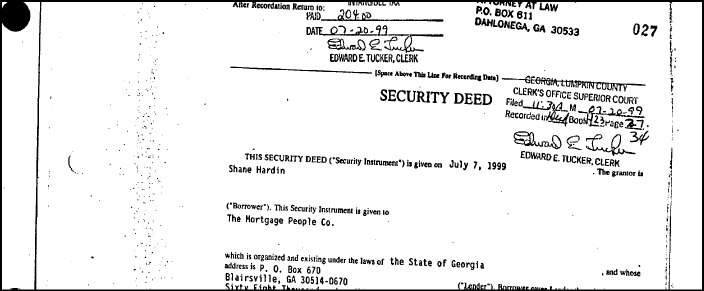
We have previously discussed that security deeds (i.e., a mortgage) can automatically expire in Georgia. If a security deed expires, the lender cannot foreclose, and the security deed no longer acts as a lien against the property, and the security deed can be canceled. Generally, under OCGA § 44-14-80, a security deed expires (1) seven years after the maturity date of the security deed, or (2) if there is a statement in the security deed that says the maturity date is perpetual or infinite, 20 years from the date of the conveyance.

Recent Quiet Title Action

The above statute was tested in a recent quiet title action. See Freeport Title & Guaranty, Inc. v. Braswell, A23A0442 (2023). In Freeport, a property owner, A, conveyed real estate to B in 2004. The owner financed the sale, meaning that B borrowed money from A to purchase the property and gave a security deed to A.

B defaulted on the loan, but A did not foreclose on the security deed until 2020. A claimed that the security deed was valid because the security deed has “perpetual/infinite” language and, therefore, the above 20-year rule applied. Conversely, B argued that the security deed (and the 2020 foreclosure) were invalid because the seven-year rule applied.

The Court of Appeals ruled for A, finding that the security deed contained sufficient language to activate the 20-year rule. The Court rejected B’s argument that the language in the security deed was insufficient to show intent for a perpetual duration.

Read the Security Deed

The lesson here is that you must closely read the security deed to determine the expiration date of a security deed. Please call us at 404-382-9994 if you have questions regarding whether a security deed on your property is enforceable and whether you are entitled to file a quiet title to remove the security deed.

Do you have an Easement?

Do you have an Easement in Georgia

Unwritten Easements

In Georgia, an easement does not need to be in writing. Easements can be created by adverse use and by implication.

Express Grant

This blog focuses on easements created by implication. When a landowner subdivides property, and the deeds to the subdivided lots describe streets, parks, and lakes, the buyers obtain an easement to use the streets, parks, and lakes.

These are called “easements by express grant” and are commonly created when a subdivision is developed. The developer will submit a subdivision plat that includes streets and parks. When the developer sells the lots in the subdivision, the deeds reference the subdivision plat. Reference to the subdivision plat that shows streets and parks create enforceable easements that allow the purchaser to use the streets and parks.

What about a golf course?

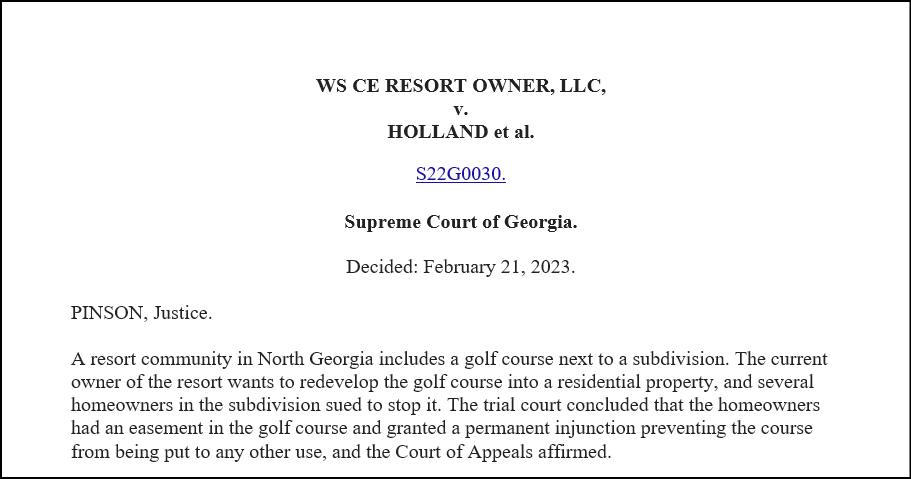
This issue was presented to the Georgia Supreme Court in WS CE Resort Owner, LLC v. Holland et al., S22G0030 (February 21, 2023). In that case, the subdivision plat referenced a golf course. The purchasers claimed that because the subdivision referenced the golf course, they automatically obtained an easement to use the golf course. The dispute arose when the owner tried converting the golf course into condominiums.

The adjoining owners objected based on their claim that they had an easement to use the golf course and, therefore, the owner could not develop it. The adjoining homeowners argued that they had relied on a marketing brochure for the neighborhood that pictured a golf course and described the intended development of smaller homes “overlooking the Par 3 golf course.”

The trial court agreed with the adjoining homeowners and stopped the development of the golf course. The golf course owner appealed. The Georgia Court of Appeals agreed with the trial court. However, the golf course owner then appealed to the Georgia Supreme Court. The Georgia Supreme Court disagreed with the trial court and the Georgia Court of Appeals. It ruled that reference to a golf course in a subdivision plat does not give subsequent purchasers an easement to use the golf course. Thus, the golf course owner was allowed to convert the golf course into condominiums.

Streets, Parks, and Lakes Referenced in a Subdivision Plat Do Create an Easement

The Supreme Court determined that merely identifying a golf course on a subdivision is insufficient to create an easement. Showing a golf course on a subdivision plat did not show a “clear intent” to set apart the designated area for the lot owners’ use or enjoyment. On the other hand, the Court clarified that streets, parks, and lakes identified on a subdivision plat create an easement for homeowners in a subdivision.

Judicial In Rem Tax Sales

Judicial in Rem Tax Sales

Recently, we have seen more judicial tax sales in Georgia. This type of sale is much different than a non-judicial tax sale. OCGA § 48-4-75. Both the procedures and the deadlines differ.

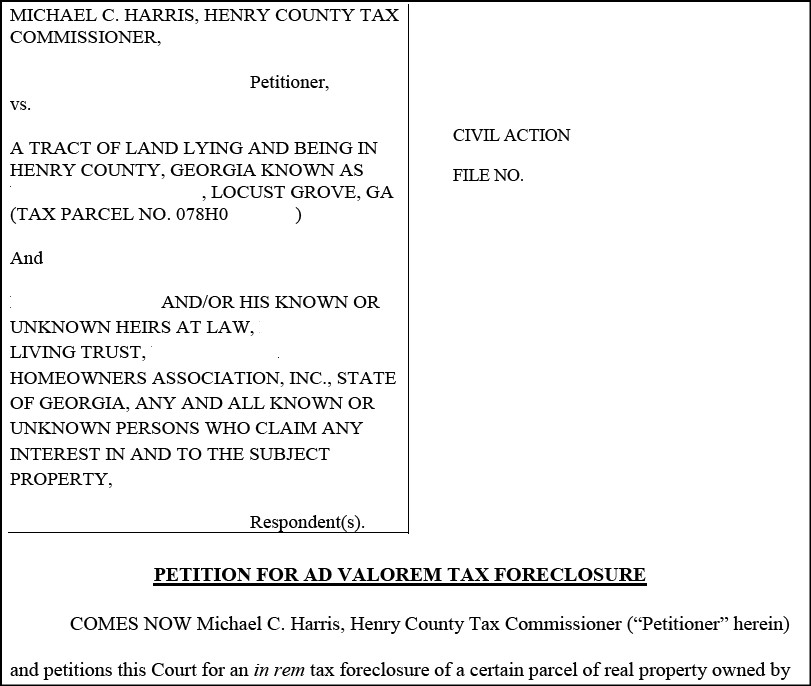
When a taxpayer fails to property taxes, a county may file a judicial-in-rem tax sale. OCGA § 48-4-78. When the county employs this type of tax sale, it files a “Petition” in the superior court. The Petition is against the property itself and anyone with an interest in the property, including the owner.

Once the county files the Petition, the county gives notice to the interested parties. OCGA § 48-4-78. The county posts the property with copies of the summons and Petition, notice to interested parties, and notice of hearing. The county also sends the documents by regular and certified mail to all interested parties. Lastly, the county publishes a legal notice in the county newspaper alerting the public. The notice runs for two weeks).

Following notice, the court holds a hearing. Any interested party has the right to be heard and to contest the allegations in the Petition at the hearing. If the superior court determines that the information in the Petition is accurate and that the county gave proper notice, the court will order the county to sell the property at an auction. OCGA § 48-4-79.

The county then advertises the sale of the property in the county’s legal newspaper for four weeks. The advertisement will show the owner’s name, a description of the property to be sold, and the amount of the tax due OCGA §§ 9-13-140-142.

Before judicial tax sale auction, an interested party may redeem the property by paying the redemption amount to the county tax commissioner. If an interested party pays the redemption amount, the county dismisses the Petition. OCGA § 48-4-80.

One of the main differences between judicial and non-judicial tax sales is that a judicial tax sale allows only 60 days to redeem (buy back the property). In a non-judicial tax sale, the owner has at least one year to redeem. OCGA § 48-4-81.

The other major difference is judicial tax sales vest title absolutely into the purchaser. In theory, this eliminates the need for post-sale barment procedures and quiet title actions. There is little case law to provide guidance, but we expect the courts to consider these issues in the future.

Surplus Foreclosure Funds

Foreclosures Surplus Funds in Georgia

In Georgia, most foreclosures are non-judicial. Meaning that the lender does not need court approval or supervision to foreclose. Thus, most foreclosures in Georgia happen “privately.” This blog post addresses the lender’s obligations to disburse surplus foreclosure funds.

A lender who forecloses on real estate assumes the obligation of properly distributing the proceeds from the foreclosure sale. Holland v. Sterling, 214 Ga. 583, 585 (1958). The lender is entitled to apply the fund from the sale first to the costs of the sale, attorney’s fees, and the interest and principal of the secured indebtedness. OCGA § 13-4-42. If there are any surplus or excess funds, the lender must pay the surplus funds to lienholders and then to the borrower.

The lender’s interest in property exists only to the extent of the amount they are owed. Thus, the lender must account to the borrower for any surplus foreclosure funds. Palmer v. Mitchell County Federal Sav. & Loan Ass’n, 189 Ga. App. 646 (1988).

If there is a legitimate dispute to the surplus foreclosure funds, the lender can file an interpleader. An interpleader is a legal action where the lender gives the money to the court. And the court decides who is entitled to the money.

If there is no legitimate dispute regarding the surplus funds, and the lender fails to timely disburse the funds, the creditor may be liable for prejudgment interest to the party entitled to such funds. OCGA § 7-4-15. Such liability will largely depend on whether the amount of such surplus is a liquidated amount. Walton Motor Sales, Inc. v. Ross, 736 F.2d 1449 (11th Cir. 1984).