
tax deed foreclosures
Continue reading
tax deed foreclosures
Continue reading

As personal injury lawyers, our primary duty to our clients is to maximize each client’s net recovery. So, while it’s great to get a significant settlement on behalf of a child, such a settlement is much smaller when a large portion must be repaid to a health insurance company or Medicaid. At Gomez & Golomb, we work hard dealing with and extinguishing any Children’s Medicaid Reimbursement claims not allowed under Georgia law.
An example is when a minor is injured. PeachCare/Medicaid often pays the medical bills and claims a lien against future settlements in these situations. After careful review, we interpret Georgia and federal law to hold that PeachCare has no right to reimbursement for any settlement with a minor. We, therefore, fight these reimbursement claims tooth and nail.
In Georgia, an injured child only has a claim for pain and suffering. Southern Guaranty Ins. Co. v. Sinclair, 228 Ga. App. 386 (1997) discusses this concept. In that case, the Court held that a minor has no claim for medical expenses because that obligation rests with the child’s parents. This reasoning makes sense because until a minor child reaches the age of 18, they cannot be bound under contract. Therefore, in a Children’s Medicaid Reimbursement situation, a child cannot be liable for medical expenses nor claim reimbursement of medical expenses.
The United States Supreme Court held that Medicaid/PeachCare can only reach settlement monies paid to reimburse medical bills following an injury. Thus, PeachCare/Medicaid can claim a lien against that part of an injured person’s recovery only for money received for medical expenses. Arkansas Dept. of Health and Human Services v. Ahlborn, 547 U.S. 268; 126 S. Ct. 1752 (2006).
Reading Sinclair and Ahlborn together, Medicaid/PeachCare cannot claim a lien against a minor child’s settlement proceeds. To shield a settlement from Peachcare/Medicaid, we structure the settlement between the wrongdoing party and the minor child. The settlement clarifies it only covers pain and suffering.
If you have a question about these issues, please call Gomez & Golomb LLC at 404-382-9994.

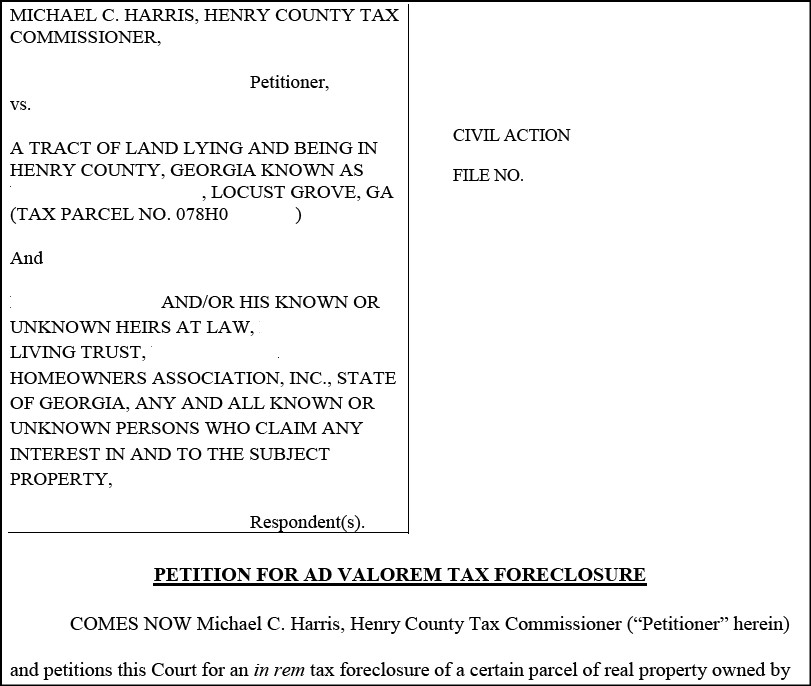
Recently, we have seen more judicial tax sales in Georgia. This type of sale is much different than a non-judicial tax sale. OCGA § 48-4-75. Both the procedures and the deadlines differ.
When a taxpayer fails to property taxes, a county may file a judicial-in-rem tax sale. OCGA § 48-4-78. When the county employs this type of tax sale, it files a “Petition” in the superior court. The Petition is against the property itself and anyone with an interest in the property, including the owner.
Once the county files the Petition, the county gives notice to the interested parties. OCGA § 48-4-78. The county posts the property with copies of the summons and Petition, notice to interested parties, and notice of hearing. The county also sends the documents by regular and certified mail to all interested parties. Lastly, the county publishes a legal notice in the county newspaper alerting the public. The notice runs for two weeks).
Following notice, the court holds a hearing. Any interested party has the right to be heard and to contest the allegations in the Petition at the hearing. If the superior court determines that the information in the Petition is accurate and that the county gave proper notice, the court will order the county to sell the property at an auction. OCGA § 48-4-79.
The county then advertises the sale of the property in the county’s legal newspaper for four weeks. The advertisement will show the owner’s name, a description of the property to be sold, and the amount of the tax due OCGA §§ 9-13-140-142.
Before judicial tax sale auction, an interested party may redeem the property by paying the redemption amount to the county tax commissioner. If an interested party pays the redemption amount, the county dismisses the Petition. OCGA § 48-4-80.
One of the main differences between judicial and non-judicial tax sales is that a judicial tax sale allows only 60 days to redeem (buy back the property). In a non-judicial tax sale, the owner has at least one year to redeem. OCGA § 48-4-81.
The other major difference is judicial tax sales vest title absolutely into the purchaser. In theory, this eliminates the need for post-sale barment procedures and quiet title actions. There is little case law to provide guidance, but we expect the courts to consider these issues in the future.


In Georgia, most foreclosures are non-judicial. Meaning that the lender does not need court approval or supervision to foreclose. Thus, most foreclosures in Georgia happen “privately.” This blog post addresses the lender’s obligations to disburse surplus foreclosure funds.
A lender who forecloses on real estate assumes the obligation of properly distributing the proceeds from the foreclosure sale. Holland v. Sterling, 214 Ga. 583, 585 (1958). The lender is entitled to apply the fund from the sale first to the costs of the sale, attorney’s fees, and the interest and principal of the secured indebtedness. OCGA § 13-4-42. If there are any surplus or excess funds, the lender must pay the surplus funds to lienholders and then to the borrower.
The lender’s interest in property exists only to the extent of the amount they are owed. Thus, the lender must account to the borrower for any surplus foreclosure funds. Palmer v. Mitchell County Federal Sav. & Loan Ass’n, 189 Ga. App. 646 (1988).
If there is a legitimate dispute to the surplus foreclosure funds, the lender can file an interpleader. An interpleader is a legal action where the lender gives the money to the court. And the court decides who is entitled to the money.
If there is no legitimate dispute regarding the surplus funds, and the lender fails to timely disburse the funds, the creditor may be liable for prejudgment interest to the party entitled to such funds. OCGA § 7-4-15. Such liability will largely depend on whether the amount of such surplus is a liquidated amount. Walton Motor Sales, Inc. v. Ross, 736 F.2d 1449 (11th Cir. 1984).

Learn more about filing a quiet title in Georgia by calling 404-382-9994.
Continue reading
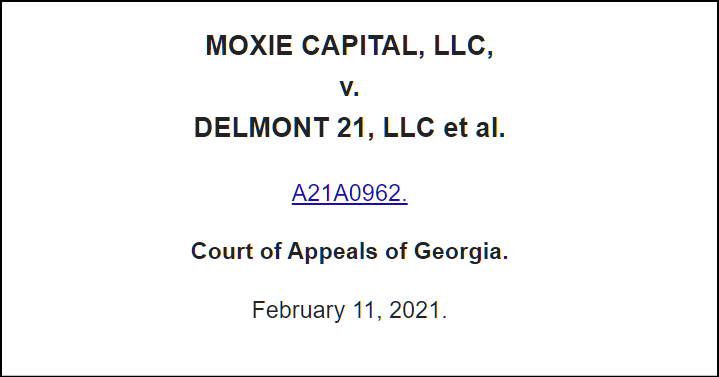
A new Georgia appellate case, Moxie Capital v. Delmont 21 (2021), has been released that every tax deed purchaser, investor, and property owner should know about. The case involves how to redeem a property following a tax sale.
OCGA § 48-4-40 says the property owner or an interest holder in the property may redeem a property following a tax sale. Redemption must occur within a twelve-month window and after a notice of right to redeem has been provided. OCGA § 48-4-42 states how much a redeeming party must pay to redeem. Importantly, the funds required to redeem “shall be paid in lawful money of the United States.”
In Moxie Capital, an investor attempted to redeem a property. For various reasons, the attempted redemption occurred on the last day of the redemption period. The investor contacted the tax deed holder for a payoff. There were conflicting versions of what happened from there. The investor said the tax deed holder did not cooperate; while the tax deed holder argued he had no obligation to cooperate.
What the parties don’t dispute is that the investor timely delivered a personal check to the tax deed holder. The investor claimed that certified funds were not available because the banks had closed by the time he found out the details of where to deliver the redemption amount. On the next day, the tax deed holder returned the personal check to the investor. And claimed that the investor’s right to redeem had expired.
Naturally, this went to court. While somewhat complicated, ultimately, the investor lost. And the tax deed purchaser got the property. The Georgia Court of Appeals ruled that to redeem, funds must be in the form of cash or certified check. The Court cited OCGA § 48-4-42, which says funds must be “paid in lawful money of the United States.” Although no Georgia court has clearly defined “lawful money,” the Georgia Court of Appeals reasoned that a personal check is a promise to pay. Thus, the Court of Appeals did not consider the investor’s personal check to be a payment.
The Court of Appeals also suggested that a tax deed purchaser has no obligation to act in “good faith” when responding to a party trying to redeem.
Moxie Capital is consistent with other Georgia cases that apply redemption statutes strictly. Some would say harshly. Whether you agree or disagree with the outcome will depend on which side of the ledger you’re on.
Regardless of if you are a tax deed purchaser or a homeowner, we will be glad to represent you to get you through the process safely.
Call Us at 404-382-9991 to speak with an attorney regarding your options!


The death of a child is considered the single worst trauma a person can go through. The stress is so great that loved ones often suffer broken-heart syndrome, which presents like a heart attack. The wrongful death of a child makes coping (and healing) that much more unimaginable.
Gomez & Golomb counsels grieving families concerning their legal rights regarding wrongful death claims. We are compassionate, honest, and genuinely care about our clients’ well-being. We are not just here to get paid, but want to make a positive difference in people’s lives.
This post addresses how the Georgia court system values the wrongful death of a child. Of course, this is not something the family wants to think about. But, in the years that follow the child’s death, recovering enough money to help the family makes ends meet is essential.
In Georgia, the person or entity who caused the child’s death must compensate the deceased child’s family for “the full value of the life.” OCGA § 51-4-2(a). Importantly, the “full value of the life” is determined from the perspective of the child who died. Placing a monetary value on such pain, suffering, and loss is difficult, but Georgia has guidelines to help a jury assign a monetary value.
The family is entitled to recover the full value of the deceased child without deducting for any of the deceased’s personal expenses had she lived. OCGA §§ 51-4-1(1), 51-4-4, 19-7-1(c). “[U]nder Georgia’s wrongful death statute, damages are measured from the decedent’s point of view.” Brock v. Wedincamp, 253 Ga. App. 275, 280 (2002).
The full value of a wrongful death of a child is comprised of two categories of damages:
(1) those items having a proven monetary value, such as lost potential lifetime earnings, income, or services, reduced to present cash value, and
(2) lost intangible items whose value cannot be precisely quantified, such as a parent’s society, advice, example and counsel as determined by the enlightened conscience of the jury.
Concerning the wrongful death of a child, the value of a child’s life is established by the enlightened conscience of an impartial jury as applied to the evidence in the case. This includes testimony as to such child’s age, life expectancy, precocity, health, mental and physical development, family circumstances, and from the experience and knowledge of human affairs on the part of the jury. Dep’t of Human Res. v. Johnson, 264 Ga. App. 730, 738 (2003).
We are here to help with any questions regarding the wrongful death of a child. Please call us at 404-382-9994.


Property taxes in Georgia are due towards the end of the year. For example, in Fulton County, 2021 taxes were due by November 15, 2021. When property taxes are not paid, the county’s taxing authority issues a fifa. A fifa acts as a lien against the property and is recorded on the county’s real estate records. The taxing authority must issue a 30-day notice to property owners before filing the fifa. The lien remains on the county’s public records until the taxpayer pays the taxes.
The most dramatic event that happens after filing a fifa is that the taxing authority may present the tax lien to the sheriff. The sheriff will use the fifa as a basis to auction the property to pay the taxes. This process is known as a tax sale.
To get taxes paid, taxing authorities in Georgia often sell their fifa’s to third-party investors. FIG and Investa are two companies that purchase tax liens.
For a taxpayer, a transfer of a tax fifa is confusing because the third party pays the county. The taxes are then owed to third-party, not the county. Thus, the county will show the taxes as paid, but the taxes are still owed.
Under Georgia law, OCGA § 48-3-19, the third-party purchasing the lien must send notice by first-class mail to the taxpayer within 60 days. In theory, this is to notify the taxpayer of whom to pay the taxes to. However, our office has had reports from taxpayers claiming they didn’t get any notice. Like the taxing authority, the third party can take the fifa to the sheriff and ask to auction the property to pay off the fifa.
If taxes are unpaid, you need to act as quickly as possible to pay the taxes to the correct party before there is a tax sale. Please call us at 404-382-9994 if you find yourself in this situation.


The Georgia legislature has passed several statutes to protect landowners against interference with and injury to their real estate. The starting point is that enjoyment of private property is an “absolute right” of every citizen. Any interference with such enjoyment creates a tort (wrongful act or an infringement of a right resulting in civil legal liability). OCGA § 51-9-1.
To the extent a person wrongfully deprives a landowner of possession of their property, the landowner can seek to recover possession and sue for damages for such injury to real estate. OCGA § 51-9-2. Similarly, if any person wrongfully interferes with a landowner’s possession, the landowner can seek damages. OCGA § 51-9-3.
Likewise, if a person wrongfully enters the landowner’s land or property without permission, a landowner to bring an action for trespass for injury to real estate. OCGA § 51-9-4. Trespass applies to persons wrongfully on land and applies to such things as improperly placed improvements or causing flooding on a landowners’ property. Anyone or anything that comes onto someone’s land due to wrongful conduct of another person can be a trespass. Suppose two persons claim possession of the same land. In that case, the person with title to the land is deeming to be rightfully in possession. In contrast, the other person is deemed to be a trespasser. OCGA § 51-9-5.
Regarding damages for trespass, such damages are limited to damages incurred up until an action is filed. OCGA § 51-9-6. Damages that occur after filing a lawsuit create a new cause of action.
Regarding streams (more formally called non-navigable watercourses), such landowners are entitled to the natural and usual flow of the stream across their property. If a person wrongfully diverts the stream from its natural and usual flow or lessens the value of the stream, this is considered trespass. OCGA § 51-9-7. The same applies to underground streams and interference of the space below and above the land’s surface. OCGA §§ 51-9-8 and 51-9-9. The last grounds for bringing a trespass action is if a person wrongfully interferes with a landowner’s right of way. OCGA § 51-9-10.
Finally, a landowner claims damages if any person wrongfully puts the landowners’ title to the property in question. OCGA § 51-9-11. When this happens, it is known as slander of title. An example would be if a person files a fraudulent deed on the public record and this deed causes the rightful owner’s title to be clouded. Clouded means that there is a possible issue with title. Wrongfully clouding title is considered an injury to real estate in Georgia.
If you are a landowner and your enjoyment of your land is being interfered with or violated, please call us at 404-382-9994 to discuss your options.


Do real estate mortgages expire after a certain amount of time? In Georgia, a security deed is the document that secures a loan on real estate. OCGA § 44-14-80 states that security deeds expire seven years after the maturity of the last installment date stated in the security deed. OCGA § 44-14-80 further says if the security deed contains no maturity date, the security deed expires after seven years.
When a security deed expires, title automatically “reverts” (goes back) to the borrower. In other words, if sufficient time has passed, the security deed is automatically cancelled. Most importantly, after the security deed is cancelled, the lender loses its lien against the property and cannot foreclose.
These concepts were the focus of a recent Georgia Court of Appeals case: Freeport Title & Guaranty. In that case, the parties disagreed whether a security deed had expired. The security deed had a space to insert a due date, but, whoever drafted the security deed, left the space blank. One party argued that the security had expired after seven years because the security deed had no maturity date. The other party responded that omitting the due date was a mistake. Instead, that party argued that the borrower and the lender had intended to include a due date.
The Georgia Court of Appeals found that the security deed had not expired after seven years. Even though the parties had not included specific date in the security deed. The court reasoned that the parties had intended to include a fixed date. In addition, the Court of Appeals ruled that the promissory note, which did include a due date, could be used to “fill in the blanks.”
The takeaway, when evaluating whether a security deed in Georgia has expired, is to consider the promissory note and the security deed . However, unlike security deeds, lenders do not record promissory notes on the public record. So getting a copy to review may be challenging.
If you have a question about a security deed, please call us at 404-382-9994 to discuss.
 Talk to an Attorney Now!