Excess Tax Sale Funds in Georgia: A Quick Review

Property

In Georgia, properties can be auctioned if the owner fails to pay property taxes. When a property is sold at a tax sale for more than the amount owed in taxes, the remaining funds are considered excess funds. These funds are typically held by the county tax commissioner’s office or the sheriff. The Georgia statute that addresses excess tax sale funds is OCGA § 48-4-5.

How long do you have?

Excess funds will be maintained for five years from the date of sale under OCGA § 48-4-5(c) before being turned over to the Georgia Department of Revenue, Unclaimed Property Division.

Who is Entitled to Excess Funds?

Generally, those who may be entitled to claim excess funds include:

  • The property owner at the time of the tax sale: If the property owner can prove ownership and has not relinquished their rights, they may be entitled to the excess funds.
  • Lien holders: Mortgage companies or other lien holders with a recorded interest in the property at the time of the tax sale may also be entitled to claim the funds.
  • Other interested parties: In some cases, other parties with a legitimate interest in the property may be able to claim excess funds.

Excess tax sale funds are paid first to lienholders with a recorded interest on the day of the tax sale (in the order the interests were recorded) and then to the property owner at the time of the tax sale.

Claim Process

Claiming excess tax sale funds can be a bureaucratic and frustrating process. It involves providing documentation to prove ownership or interest in the property and filing a claim with the county tax commissioner’s office. The specific requirements and procedures vary by county.

Claiming excess tax sale funds can be challenging for several reasons:

  • Documentation requirements: Proving ownership or interest in a property can be difficult, especially if the property has changed hands multiple times or records are incomplete.
  • Bureaucratic hurdles: Like many government agencies or large corporations, filing a claim can be time-consuming and frustrating, with unnecessary bureaucratic obstacles.

If you are entitled to excess tax sale funds, here are some tips:

  • Act promptly: Research the time limits for filing claims in your county and act quickly.
  • Gather documentation: Collect relevant documents, such as deeds, mortgages, and property tax records.
  • Consult an attorney: An attorney can help you navigate the legal process and protect your rights.

Would you like to know more about a specific aspect of excess tax sale funds in Georgia, such as the time limits for filing claims or the documentation required? Please call us at 404-382-9994; we’ll happily answer any questions.  

Quiet Your Title Worries: Overview of Marketable Title in Georgia

Types of Property Tax

Owning property in Georgia is a dream for many, but title issues can turn that dream into a nightmare. If you’re facing a cloud on your title – a potential claim that could prevent you from selling or refinancing your property – a quiet title action can be the solution.

Marketable Title

Marketable title is a legal term that refers to a property title free from any claims or disputes that could reasonably be expected to affect its value or ownership. In essence, it’s a title that a prudent buyer would be willing to accept.

What is a Quiet Title Action?

A quiet title action is a lawsuit allowing you to clear up doubts about the property’s rightful owner. By filing a quiet title lawsuit, you’re asking the court to declare you the owner and “quiet” any challenges to your title.

Types of Quiet Title

There are two types in Georgia: (1) conventional and (2) against all the world. Conventional is used when you must cancel a particular deed that is clouding your title. Against all the world is used when unknown persons may own your property. An example of a conventional type is if someone filed a fraudulent deed against your property, while an example of an against the world type is if you find out the person who sold you your property did not have full title; if you can’t find that person, you must file a quiet title against all the world.

Why Would I Need a Quiet Title Action in Georgia?

You might need a quiet title action in Georgia for several reasons. Here are a few common ones:

  • Heir Property: If you inherited property and there are questions about the validity of the will or the rights of other heirs, a quiet title action can help solidify your ownership.
  • Boundary Disputes: Unsure exactly where your property line ends? A quiet title action can help establish the legal boundaries of your land.
  • Tax Sales: A quiet title action is normally needed to clear the title following a tax sale.
  • Errors in Public Records: Mistakes on deeds or other public records can create clouds on title. A quiet title action can correct these errors.
  • Fraudulent Deeds: If someone fraudulently (or unintentionally) records a deed that shows up in your chain of title (the deeds that show you own the property, a quiet title is needed.
  • Uncancelled Loans: If you use your property as collateral to get a loan (i.e., a mortgage), the lender places a security deed on your property. Once you pay off the loan, the lender is supposed to cancel the security deed. Sometimes, for various reasons, the lender fails to cancel the security deed. For example, if a lender goes out of business, there may be no one to cancel the security deed.
  • Gaps in Ownership: When you sell your property, an attorney may call you to say that there is a gap in your ownership. For example if A sells to B and B sells to C, but you got your property from D, you have a title problem problem becuase you need a deed from C.

The Benefits of a Quiet Title Action in Georgia

A successful quiet title action provides several benefits:

  • Peace of Mind: Knowing your title is clear lets you relax and enjoy your property.
  • Increases Property Value: Properties with marketable title are more valuable than those with title issues.
  • Marketability: Without a clear title, you will likely be unable to sell your property.
  • Loan Approval: A clear title is essential for loan approval if you want to refinance your property.

The Quiet Title Process in Georgia

  1. Consult with a Real Estate Attorney: An experienced attorney can advise you on whether a quiet title action is right for you and guide you through the process.
  2. File a Lawsuit: The attorney will file a petition with the Superior Court in the county where the property is located.
  3. Serve Notice: The court will require that all potential claimants be served with the lawsuit.
  4. Special Master Appointment: In a quiet title against all the world, and sometimes in a conventional quiet title, the court will appoint a special master to investigate the claims and make recommendations.
  5. Court Hearing: The court or the special master will hold a hearing to determine property ownership.
  6. Judgment: The court will issue an order declaring the rightful owner. This order will then be filed on the county’s real estate records. Recording the court order gives you clear title.

Get Help With Your Quiet Title Action in Georgia

If you’re facing a cloud on your title in Georgia, don’t hesitate to seek help. We can advise you on your best course of action and ensure a smooth and successful quiet title process. Call us at 404-382-9994.

Judicial In Rem Tax Sales

Judicial in Rem Tax Sales

Recently, we have seen more judicial tax sales in Georgia. This type of sale is much different than a non-judicial tax sale. OCGA § 48-4-75. Both the procedures and the deadlines differ.

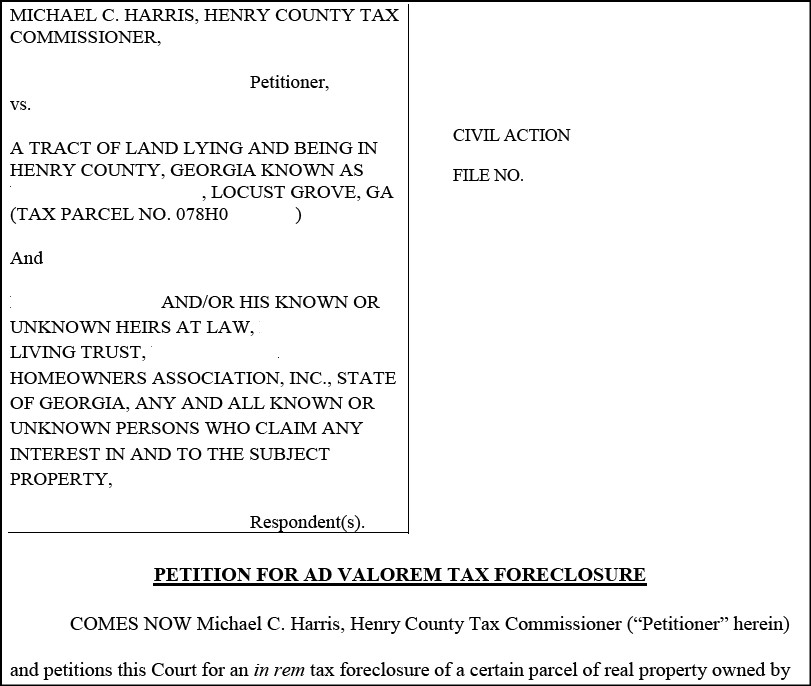
When a taxpayer fails to property taxes, a county may file a judicial-in-rem tax sale. OCGA § 48-4-78. When the county employs this type of tax sale, it files a “Petition” in the superior court. The Petition is against the property itself and anyone with an interest in the property, including the owner.

Once the county files the Petition, the county gives notice to the interested parties. OCGA § 48-4-78. The county posts the property with copies of the summons and Petition, notice to interested parties, and notice of hearing. The county also sends the documents by regular and certified mail to all interested parties. Lastly, the county publishes a legal notice in the county newspaper alerting the public. The notice runs for two weeks).

Following notice, the court holds a hearing. Any interested party has the right to be heard and to contest the allegations in the Petition at the hearing. If the superior court determines that the information in the Petition is accurate and that the county gave proper notice, the court will order the county to sell the property at an auction. OCGA § 48-4-79.

The county then advertises the sale of the property in the county’s legal newspaper for four weeks. The advertisement will show the owner’s name, a description of the property to be sold, and the amount of the tax due OCGA §§ 9-13-140-142.

Before judicial tax sale auction, an interested party may redeem the property by paying the redemption amount to the county tax commissioner. If an interested party pays the redemption amount, the county dismisses the Petition. OCGA § 48-4-80.

One of the main differences between judicial and non-judicial tax sales is that a judicial tax sale allows only 60 days to redeem (buy back the property). In a non-judicial tax sale, the owner has at least one year to redeem. OCGA § 48-4-81.

The other major difference is judicial tax sales vest title absolutely into the purchaser. In theory, this eliminates the need for post-sale barment procedures and quiet title actions. There is little case law to provide guidance, but we expect the courts to consider these issues in the future.

Tax Deed Redemption: Tricks of the Trade

Tax Deed Redemption Tricks of the Trade

Redemption Process

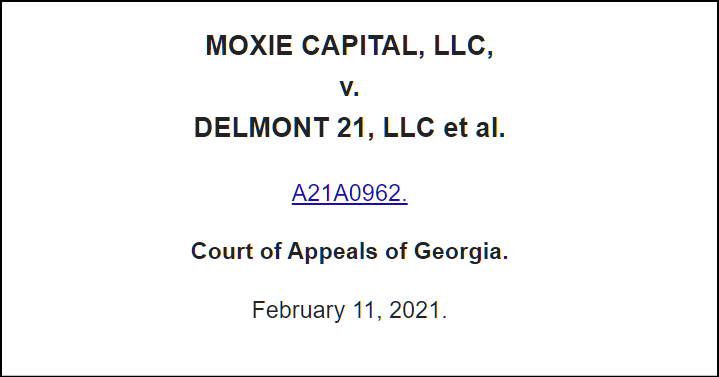
A new Georgia appellate case, Moxie Capital v. Delmont 21 (2021), has been released that every tax deed purchaser, investor, and property owner should know about. The case involves how to redeem a property following a tax sale.

OCGA § 48-4-40 says the property owner or an interest holder in the property may redeem a property following a tax sale. Redemption must occur within a twelve-month window and after a notice of right to redeem has been provided. OCGA § 48-4-42 states how much a redeeming party must pay to redeem. Importantly, the funds required to redeem “shall be paid in lawful money of the United States.”

Redemption Dispute

In Moxie Capital, an investor attempted to redeem a property. For various reasons, the attempted redemption occurred on the last day of the redemption period. The investor contacted the tax deed holder for a payoff. There were conflicting versions of what happened from there. The investor said the tax deed holder did not cooperate; while the tax deed holder argued he had no obligation to cooperate.

What the parties don’t dispute is that the investor timely delivered a personal check to the tax deed holder. The investor claimed that certified funds were not available because the banks had closed by the time he found out the details of where to deliver the redemption amount. On the next day, the tax deed holder returned the personal check to the investor. And claimed that the investor’s right to redeem had expired.

Naturally, this went to court. While somewhat complicated, ultimately, the investor lost. And the tax deed purchaser got the property. The Georgia Court of Appeals ruled that to redeem, funds must be in the form of cash or certified check. The Court cited OCGA § 48-4-42, which says funds must be “paid in lawful money of the United States.” Although no Georgia court has clearly defined “lawful money,” the Georgia Court of Appeals reasoned that a personal check is a promise to pay. Thus, the Court of Appeals did not consider the investor’s personal check to be a payment.

The Court of Appeals also suggested that a tax deed purchaser has no obligation to act in “good faith” when responding to a party trying to redeem.

Don’t Wait Until the Last Minute – Call Us

Moxie Capital is consistent with other Georgia cases that apply redemption statutes strictly. Some would say harshly. Whether you agree or disagree with the outcome will depend on which side of the ledger you’re on.

Regardless of if you are a tax deed purchaser or a homeowner, we will be glad to represent you to get you through the process safely.

Call Us at 404-382-9991 to speak with an attorney regarding your options!

TRANSFER OF TAX FIFA’S IN GEORGIA

TRANSFER OF TAX FIFA’S IN GEORGIA

Property taxes in Georgia are due towards the end of the year. For example, in Fulton County, 2021 taxes were due by November 15, 2021. When property taxes are not paid, the county’s taxing authority issues a fifa. A fifa acts as a lien against the property and is recorded on the county’s real estate records. The taxing authority must issue a 30-day notice to property owners before filing the fifa. The lien remains on the county’s public records until the taxpayer pays the taxes.

The most dramatic event that happens after filing a fifa is that the taxing authority may present the tax lien to the sheriff. The sheriff will use the fifa as a basis to auction the property to pay the taxes. This process is known as a tax sale.

To get taxes paid, taxing authorities in Georgia often sell their fifa’s to third-party investors. FIG and Investa are two companies that purchase tax liens.

For a taxpayer, a transfer of a tax fifa is confusing because the third party pays the county. The taxes are then owed to third-party, not the county. Thus, the county will show the taxes as paid, but the taxes are still owed.

Under Georgia law, OCGA § 48-3-19, the third-party purchasing the lien must send notice by first-class mail to the taxpayer within 60 days. In theory, this is to notify the taxpayer of whom to pay the taxes to. However, our office has had reports from taxpayers claiming they didn’t get any notice. Like the taxing authority, the third party can take the fifa to the sheriff and ask to auction the property to pay off the fifa.

If taxes are unpaid, you need to act as quickly as possible to pay the taxes to the correct party before there is a tax sale. Please call us at 404-382-9994 if you find yourself in this situation.

In Georgia, how long do you have to tender the statutory redemption amount following a tax sale and how much do you have to pay?

OCGA § 48-4-42 says: “The amount required to be paid for redemption of property from any sale for taxes . . . shall . . . be the amount paid for the property at the tax sale . . . plus a premium of 20 percent of the amount for the first year or fraction of a year which has elapsed between the date of the sale and the date on which the redemption payment is made and 10 percent for each year or fraction of a year thereafter.”

OCGA § 48-4-40 says the tax deed purchaser may terminate the right to redeem one year after the tax sale by sending out notices to any interested parties. The notice regarding the tax deed must include a deadline to redeem.  

It sounds simple enough, but what if the parties can’t agree on an amount? And what if a party redeems within the deadline by mistakenly pays less than the full redemption amount required under the statute? This situation arose in D&D Family Properties, LLC v. Wright, A20A1339 (November 3, 2020).

In Wright, the tax sale took place on July 5, 2017. The Court of Appeals found that the deadline starts running on the date of the tax sale. Thus, the deadline to redeem fell on July 4 of the following year. The redeeming party submitted $7,600 on July 5 ($6,000 for the amount paid at the tax sale plus the 20% premium). It did this thinking the one-year deadline ran on July 5. Or because July 4 was a holiday, the deadline rolled over to the next business day.

The Court of Appeals disagreed. It ruled that by July 5, the redeeming party owed an additional 10%. Thus, the $7,600 was inadequate, and the redeeming party could not redeem.

The takeaway is the Court of Appeals is willing to strictly enforce the statutes regarding tax sales.