Georgia Tax Deed Purchasers Are Responsible for Paying Association Dues

Under Georgia law, a tax deed purchaser is obligated to pay homeowners’ association assessments that come due after the tax sale. See Croft v. Fairfield Plantation Property Owners Assn., 276 Ga. App. 311, 314 (2005). This includes the period before the purchaser can foreclose on the right of redemption. Georgia courts have held that a tax deed purchaser acquires sufficient title to trigger automatic membership in the association. The rationale is that assessments and fees paid to a homeowners’ associations benefit a tax deed purchaser.

The good news for tax deed holders is that Georgia courts allow tax deed holders to include condominium association assessments paid as part of the redemption price. Harvest Assets, LLC v. Northlake Manor Condo. Assn., 340 Ga. App. 237 (2017).

Georgia Tax Deeds: Excess Tax-Sale Funds and Super Liens

There was an important shift in Georgia tax deed law last year. The Georgia Supreme Court, in DLT List, LLC vs. M7even, 301 Ga. 131 (2017), decided that a party who redeems a tax deed is not automatically first in line to receive excess tax-sale funds following a tax sale.

The facts of DLT List are straightforward: a property was auctioned at a tax sale and sold for $110,000. The delinquent taxes were $5,000, so there were $105,000 in excess tax-sale funds. The delinquent taxpayer applied to the tax commissioner to receive the excess funds–there were no other claims to the funds. Several months later, a third-party, who held a lien against another property owned by the delinquent taxpayer, redeemed. The redeeming party applied for the excess tax-sale funds. The question became who was entitled to the excess tax-sale proceeds.

Under existing law in Georgia, a redeeming party, simply by virtue of redeeming, is entitled to first position against excess tax-sale funds. This arose out of an often-cited case, National Tax Funding vs. Harpagon, 277 Ga. 41 (2003), which involved competing lien holders in the context of a tax sale. Harpagon held that following a tax sale, a competing lien holder had two choices: (1) claim the excess tax-sale funds, or (2) redeem the property. Importantly, if a competing lien holder chose to redeem, the redemption converted the competing lien holder’s claim into a first-position lien against the property. This is known as a “super lien” and allows a redeeming party to leapfrog over higher priority creditors. A super lien has many benefits for tax sale investors.

Redeeming parties, relying on the super lien language in Harpagon, began claiming their super lien status not only gave them a first-position lien against the property, but also entitled them to the excess tax-sale funds following redemption. These claims were affirmed by the courts in cases like Wester v. United Capital Financial of Atlanta, LLC, 282 Ga. App. 392 (2006).

Fast forward to 2017.  In DLT List, LLC vs. M7even, the Georgia Supreme Court revisited the issue of excess tax-sale funds and found that super liens attach only to real estate, not to personal property. Therefore, because excess tax-sale funds are personal property, super liens don’t attach to excess tax-sale funds. Thus, redeeming parties aren’t entitled to any preference with regard to excess tax-sale funds. By so deciding, the Supreme Court distinguished Harpagon and overruled cases like Wester.

While this ruling isn’t likely to slow down the tax deed business in Georgia, as a real estate investor, it’s something to be aware of.

Bankruptcy: repeat filings

A question we get frequently, especially after a debtor files a second or third bankruptcy as a delay strategy, is just how many times can a debtor get away with filing for bankruptcy? We refer to these folks, not so affectionately, as “serial filers.” While not perfect, there are some restrictions for debtors filing multiple bankruptcies:

180 days: A debtor can’t file a second bankruptcy case for 180 days if the debtor’s case was dismissed (i.e., the bankruptcy wasn’t completed) for the following reasons: (1) by the court for willful failure of the debtor to abide by orders of the court, or to appear before the court in proper prosecution of the case; or (2) the debtor requested and obtained the voluntary dismissal of the case following the filing of a request for relief from the automatic stay.

Two bankruptcies in one year: When a debtor files a second bankruptcy within one year of the dismissal of the first case, the automatic stay expires 30 days after filing (11 U.S.C. § 362(c)(3)). There’s one exception, which is if the debtor can prove to the court that the second case was filed in good faith (meaning the debtor didn’t file repeatedly to delay collection by a creditor), the court has discretion to extend the automatic stay.

Three bankruptcies in one year: When a debtor files a third bankruptcy within one year of the dismissal of the first case, the automatic stay doesn’t take effect at all upon the third filing (11 U.S.C. § 362(c)(4)).

After successful completion of a bankruptcy (i.e., a discharge): For a Chapter 7 bankruptcy, a debtor is not eligible for a discharge if the debtor received a discharge in another Chapter 7 filed within the prior eight years, or in a Chapter 13 case filed in the prior six years (unless the prior Chapter 13 payment plan either paid 100% of the unsecured claims or paid 70% of the unsecured claims). For a Chapter 13 bankruptcy, a debtor is not eligible for a discharge if the debtor received a discharge in another Chapter 13 case filed in the prior two years, or in a Chapter 7 case filed in the prior four years.

Miscellaneous note: The one-year period for either termination or non-application of the stay begins to run from the date of dismissal of the first case. In a joint case, if only one of the debtors had a prior case dismissed in the year before filing, the automatic stay is affected only as to the debtor with the prior case. Section 362(c) (3) and (4) apply to the acts of a specific debtor rather than joint debtors in the aggregate.

Please call us if you need clarification or have any questions.

Interesting Homeowners’ Association Dispute

For Georgia real estate litigation nerds, a recent case issued by the Georgia Court of Appeals provides interesting reading. The case, Great Water Lanier, LLC v. Summer Crest at Four Seasons on Lanier Homeowners Association, Inc., A17A1810 (January 2, 2018), involves a convoluted dispute between an investor and a homeowners’ association (HOA). At issue were whether a property was subject to an HOA. The owner of the property asked a court in Hall County to find that the parcel was not subject to the HOA, while the HOA requested the opposite and asked that the property owner pay HOA dues.

The Court of Appeals recited well-settled Georgia law that a person that purchases property is bound by terms in the deed that conveys the property (whether the buyer likes it or not).

The warranty deed in question referred to the HOA, but did so in an arguably ambiguous way. In addition, there were documents signed by the parties that showed the property was not intended to be a part of the HOA. After applying the rules of contract construction to the warranty deed, the Court of Appeals determined the language was not ambiguous, and therefore the language referencing the HOA in the warranty deed controlled over any other documents.

The takeaway is to carefully examine the warranty deed and all other documents when purchasing property.

Redeem a (Non-Judicial) Tax Deed

In Georgia, when property taxes are unpaid, a county is entitled to auction the property to the highest bidder to recover the unpaid property taxes. There are two types of auctions: non-judicial and judicial. This post only covers redeeming a property following a non-judicial tax sale, which includes most tax sales in Georgia.

Following a non-judicial tax sale, the taxpayer or any person who holds right, title, interest in, or a lien on the property may redeem the property within 12 months from the date of sale by paying the redemption amount. OCGA § 48-4-40. Redeeming means paying the tax deed purchaser to get the property back. The property may be redeemed at any time after the initial 12 months until the tax sale buyer forecloses (or terminates) the right to do so by giving proper notice.

To redeem a property following a tax sale, the redeeming party must pay the amount paid for the property at the tax sale, plus any taxes paid on the property by the purchaser after the sale for taxes, plus any special assessments on the property, plus a premium of 20 percent of the amount for the first year, plus 10 percent for each year after that. OCGA § 48-4-2.

After 12 months from the date of the tax sale, the purchaser can forever bar redemption of the property by giving notice to the delinquent taxpayer, the occupant, if any, and upon all persons having recorded any right, title, interest in, or lien on the property. OCGA § 48-4-5.

Suppose the property is not redeemed within the initial 12 month period or within the time allowed under the notice of the right of foreclosure. In that case, redemption is no longer allowed. OCGA § 48-4-47.

Whether you’re buying a tax deed or seeking to redeem a tax deed, please call us at 404-382-9994 to discuss your options.

Serving a Lawsuit in Georgia: Understanding the Sheriff’s Entry of Service Form

In Georgia, with some exceptions, the opposing party a/k/a the defendant must be “personally” served before a lawsuit can go forward. This means the lawsuit must be physically handed to the defendant. If the defendant is a corporation, service is made on the corporation’s registered agent. (Every corporation in Georgia is required to appoint a registered agent—this information can be found on the Georgia Secretary of State’s website.)

Service usually begins by providing the sheriff a copy of the complaint, summons, and sheriff’s entry of service form. Service by the sheriff typically takes two to three weeks, during which time a sheriff’s deputy will complete the form and mail it back to the filing party. What does this form mean? Below is the relevant part of the form and how we address the various types of service in our office:
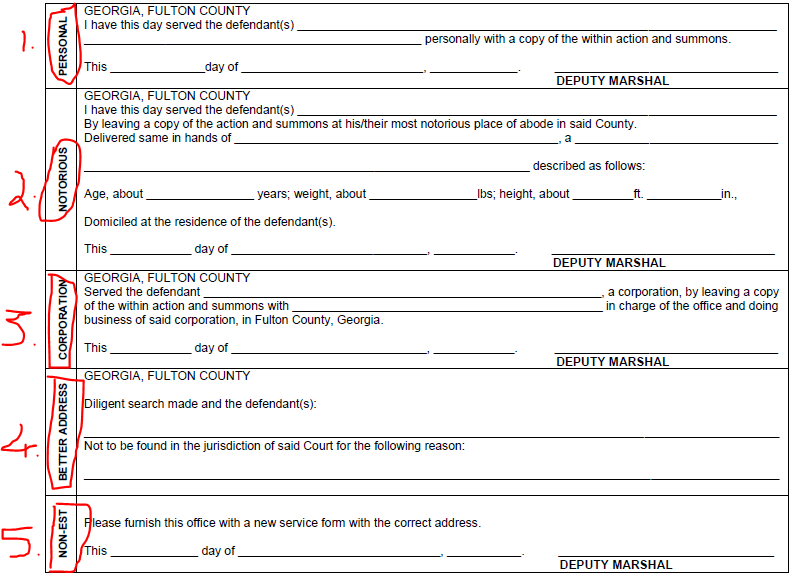
If the “personal” box is completed (box # 1 above), almost always, the sheriff has handed the paperwork to the opposing party and service is complete. Now we can get to work on the case.

If the “notorious” box is checked (box # 2 above)  this means the sheriff has handed the paperwork to someone over 18 years old who lives the opposing party. Georgia law allows notorious service, but, in our experience, we should be cautious in these situations because notorious service is sometimes unreliable and can challenged. Fortunately, an answer is due from the opposing party 30 days after service. If service isn’t contested in the answer, we no longer need to worry about service. If service is contested in the answer and seems reasonable, we will discuss with you the merits of repeating service. Ultimately, getting proper service is important because if we don’t have proper service, any judgment we obtain might be overturned.

The “corporation” box  (box # 3 above) obviously applies to serving a corporation. If this is checked, generally, this ends up being successful service.

If the “better address” box is checked (box # 5 above)  this means the person living at the address provided has told the sheriff that opposing party has moved.

Finally, the dreaded “non-est” box  box # 5 above): this means the sheriff has gone to the address provided but was unable to serve the defendant. Most importantly, this means the lawsuit can’t continue. At this point, we need to determine if we have a good address for the opposing party. A defendant can be served at home, work, church, etc. If we are confident we have a good address despite the sheriff being unsuccessful, we recommend hiring a private process server. Unlike the sheriff, a private process server will work with us and has a much better chance of successfully serving the defendant. The cost for a private process server is about $100, but goes up depending on difficulty. If we aren’t confident that we have a good address, we recommend hiring an investigator to find a good address for the defendant. This is more expensive and will cost $250 and upwards.

If we still can’t find the defendant or believe the defendant is avoiding service, we’re entitled to ask the court to allow us to serve the opposing party by publication. We’ll address service by publication in a separate blog.

We hope this gives you a better idea regarding service of a lawsuit in Georgia. If you have any questions, please don’t hesitate to call us at 404-382-9994.

Foreclosure Confirmations: True Market Value Revisited

Conyers 138, LLC et al. v. ONH1, LLC, A17A0145, June 2, 2017, concerns the unique Georgia proceeding that allows foreclosures to be retroactively confirmed by petition in Superior Court. The purpose of a confirmation is to verify the property sold at foreclosure for the fair market value, thereby permitting the lender to sue the borrower to recover the difference between the loan amount and the amount at foreclosure. If the property sells for less than fair market value at the foreclosure, then the lender can’t pursue a deficiency claim against the borrower.

In Conyers 138, LLC, the lender’s appraiser testified the market value of the property was $2,510,000, but to arrive at the fair market value, he subtracted $765,000 for demolition because he contended the best use of the property was as raw, vacant land. The borrower argued that estimate of the demolition cost was inflated because the demolition company used a faulty methodology. The Court of Appeals rejected this argument, stating disputes such as which methodology to apply are factual disputes best evaluated and decided by the trial judge. “The trial judge is the judge of credibility of the witnesses and of the weights to be given to the evidence.” (citations and punctuation omitted).

Since there was some evidence presented that supported the trial court’s decision, the Court of Appeals refused to disturb the trial court’s ruling. The takeaway is that the trial court has a lot of leeway and that it’s an uphill battle to successfully appeal a trial court’s decision in a foreclosure confirmation proceeding.

In Georgia: What To Do When Your Tenant Files for Bankruptcy?

Over the years, we’ve learned that for landlords, time is money. A three-day delay to file an eviction can mean losing a month’s rent. Similarly, when a delinquent tenant files bankruptcy, this can cause a two or three month delay, during which time most tenants pay no rent. For a landlord, dealing with a non-paying tenant, and trying to navigate the rules and laws of bankruptcy court, is a challenge. To make things worse, this is not an easy area of law, even for practicing bankruptcy lawyers.  “Executory contracts” have been described as the most “psychedelic” law in bankruptcy. Jay Lawrence Westbrook, Article: A Functional Analysis of Executory Contracts, 74 Minn. L. Rev. 227, 228 (1989)

While there are many issues you can handle without a lawyer, this is one in which you are most likely best served by getting professional advice. This blog only scratches the surface. Please call us for a free consultation if you find yourself in this situation.

Examples of executory contracts are long-term purchase agreements; service contracts; settlement agreements; insurance contracts; employment contracts; and construction contracts. When a party to an executory contract files a bankruptcy, an “automatic stay” of all collection and enforcement proceedings goes into effect at the time of filing. The automatic stay prevents eviction proceedings or other legal action – either for possession or for money damages. As a general rule, if this happens, approval from the bankruptcy court is required to proceed in the underlying action. This means moving for relief from stay. But sometimes filing a motion for relief from stay is unnecessary.

Section 365 is the place in the bankruptcy code that provides guidance on these issues. The rationale behind section 365 is to give the debtor and/or the trustee ample opportunity to decide which prepetition contracts and unexpired leases are beneficial to the bankruptcy estate and should be assumed and retained or assigned, and which are detrimental and should be rejected. Different executory contracts and unexpired leases receive different treatment and are subject to different requirements under section 365.

1. Unexpired Residential Real Property Leases and Unexpired Personal Property Leases in Chapter 7: Under section 365(d)(1), if the trustee does not assume or reject an executory contract or lease within 60 days after the order for relief (or within such additional time as the court may fix for cause), then the contract or lease is deemed rejected. This can be helpful to a landlord, especially if the 60 days is approaching.

2. Unexpired Residential Real Property Leases and Unexpired Personal Property Leases in Chapter 11 or 13: Under section 365(d)(2), executory contracts and unexpired residential real property and personal property leases can be assumed or rejected prior to, and including, plan confirmation. However, 365(d)(2) provides that the nondebtor party may request the court to order the trustee of debtor-in-possession either accept or reject within a specified time period.

3. Unexpired Non-Residential Real Property Leases Sections 365(d)(3) and (d)(4) provide extensive protection for nondebtor parties to non-residential real property leases: Upon filing the petition (the original bankruptcy filing), the Code requires the debtor or the trustee in Chapter 7 cases to timely perform all obligations of the lease from that date until the lease is assumed or rejected. If the debtor or trustee fails in that duty, the landlord may seek relief from the automatic stay and proceed with its remedies, which include an action for possession of the premises. The trustee or debtor-in-possession cannot retain possession of the nonresidential real property without paying rent or incurring an administrative expense claim for the payment of rent in the amount called for under the lease that accrues after the order for relief. Section 365(d)(4) provides that if a lease of non-residential real property (where the debtor is the lessee) is not assumed by the earlier of (a) 120 days from the order of relief, or (b) the entry of the confirmation order – it is deemed rejected and the property must be immediately surrendered to the lessor.

Foreclosure Confirmation Victory

Congratulations to the Bloom Sugarman Everett law firm for winning a foreclosure confirmation at trial and having the ruling affirmed by the Georgia Court of Appeals. Eagle GA | SPE LLC v. Atreus Communities of Fairburn Inc., 319 Ga. App. 844 (2013).

Confirmation Hearing

Atreus involved 13-developed lots, which were foreclosed for $155,000. As is typical in these type of cases, this confirmation hearing ended up being a battle of the appraisal experts. Here, the trial court found that $155,000 was less than the fair market value for the subject property and denied confirmation.

The trial court found that the lender’s appraiser failed to consider the sales comparison approach to value the property as required by the Uniform Standards of Professional Appraisal Practice (USPAP), wrongly calculated the tax liability of the property, and admitted the absorption period in his report was a “guestimate.” The trial court also found that the expert’s discounted cash flow model to be unreliable and unsupported.

On the other hand, the bulk sales comparison used by the borrower’s appraiser was found to be credible. This approach resulted in an appraisal of $228,000.

Property Appraisal

The Georgia Court of Appeals agreed with the trial court because the record showed the lender’s appraiser failed to support his opinions with reliable facts, and failed to consider the more reliable bulk sales comparison. The Court of Appeals noted that the trial court is entitled to weigh the evidence and judge the credibility of both experts. Because the record contained evidence to support the trial court’s ruling, the Court of Appeals was not in a position to second-guess the trial court.

Resale

Next, the lender contended that the trial court erred in not ordering a resale of the property under OCGA Sec. 44-14-161(c). The Court of Appeals found that a lender is not entitled to a resale simply because there may have been a flawed appraisal; and, moreover, the decision to order a resale is wholly at the discretion of the trial court.

At Gomez & Golomb LLC, we have handled many foreclosure confirmation hearings, both for the lender and for the borrower. If you have any questions, please call us at (404) 382-9994.