

Recover punitive damages in Georgia (even without injuries)

Punitive Damages: Generally

If you’re involved in an car wreck and the conduct of the party who caused the collision was reckless and intentional, you may be entitled to punitive damages. The two most common examples of misconduct that warrant punitive damages are hit and run and drunk driving. Also, whether the offending party has a history of reckless driving is an important factor. The purpose of of punitive damages isn’t to make the injured party whole, but rather to send a forceful message to the offending party and the public that reckless driving won’t be tolerated. Probably everyone can agree that limiting reckless driving is a worthwhile undertaking.

O.C.G.A. § 51-12-5.1(b) provides that “[p]unitive damages may be awarded in such actions in which it is proven by clear and convincing evidence that the defendant’s actions showed willful misconduct, malice, fraud, wantonness, oppression, or that entire want of care which would raise the presumption of conscious indifference to consequences.”  O.C.G.A. § 51-12-5.1(c) further states that punitive damages “shall be awarded not as compensation to a plaintiff but solely to punish, penalize, or deter a defendant.”

Leaving the scene and driving under the influence are examples of of wilful misconduct, wantonness, and that want of care that shows conscious indifference to the consequences. According to O.C.G.A. § 51-12-5.1(f), in these situations, a jury is entitled to award the injured party unlimited punitive damages:

In a tort case in which the cause of action does not arise from product liability, if it is found that the defendant acted, or failed to act, with the specific intent to cause harm . . . there shall be no limitation regarding the amount which may be awarded as punitive damages . . .”

Punitive Damages: Property Damage Claims

In Georgia, punitive damages are recoverable in a property damage claim even if there are no injuries. Bowen v. Waters, 170 Ga. App. 65 (1984), aff’d, 175 Ga. App. 884 (1985) (“While an award of punitive damages is authorized only where a tortfeasor’s conduct is of an aggravated nature, such an award may properly be based upon an aggravated tort involving only property rights.”).

At Gomez & Golomb, unlike some others, we’re not a cookie cutter personal injury law firm. We devote our full attention to each case so that we maximize your recovery. If you’re in a collision, please call us to discuss whether your case is the type that might justify punitive damages, and what other damages you might be entitled to.

Redeem a (Non-Judicial) Tax Deed

In Georgia, when property taxes are unpaid, a county is entitled to auction the property to the highest bidder to recover the unpaid property taxes. There are two types of auctions: non-judicial and judicial. This post only covers redeeming a property following a non-judicial tax sale, which includes most tax sales in Georgia.

Following a non-judicial tax sale, the taxpayer or any person who holds right, title, interest in, or a lien on the property may redeem the property within 12 months from the date of sale by paying the redemption amount. OCGA § 48-4-40. Redeeming means paying the tax deed purchaser to get the property back. The property may be redeemed at any time after the initial 12 months until the tax sale buyer forecloses (or terminates) the right to do so by giving proper notice.

To redeem a property following a tax sale, the redeeming party must pay the amount paid for the property at the tax sale, plus any taxes paid on the property by the purchaser after the sale for taxes, plus any special assessments on the property, plus a premium of 20 percent of the amount for the first year, plus 10 percent for each year after that. OCGA § 48-4-2.

After 12 months from the date of the tax sale, the purchaser can forever bar redemption of the property by giving notice to the delinquent taxpayer, the occupant, if any, and upon all persons having recorded any right, title, interest in, or lien on the property. OCGA § 48-4-5.

Suppose the property is not redeemed within the initial 12 month period or within the time allowed under the notice of the right of foreclosure. In that case, redemption is no longer allowed. OCGA § 48-4-47.

Whether you’re buying a tax deed or seeking to redeem a tax deed, please call us at 404-382-9994 to discuss your options.

Serving a Lawsuit in Georgia: Understanding the Sheriff’s Entry of Service Form

In Georgia, with some exceptions, the opposing party a/k/a the defendant must be “personally” served before a lawsuit can go forward. This means the lawsuit must be physically handed to the defendant. If the defendant is a corporation, service is made on the corporation’s registered agent. (Every corporation in Georgia is required to appoint a registered agent—this information can be found on the Georgia Secretary of State’s website.)

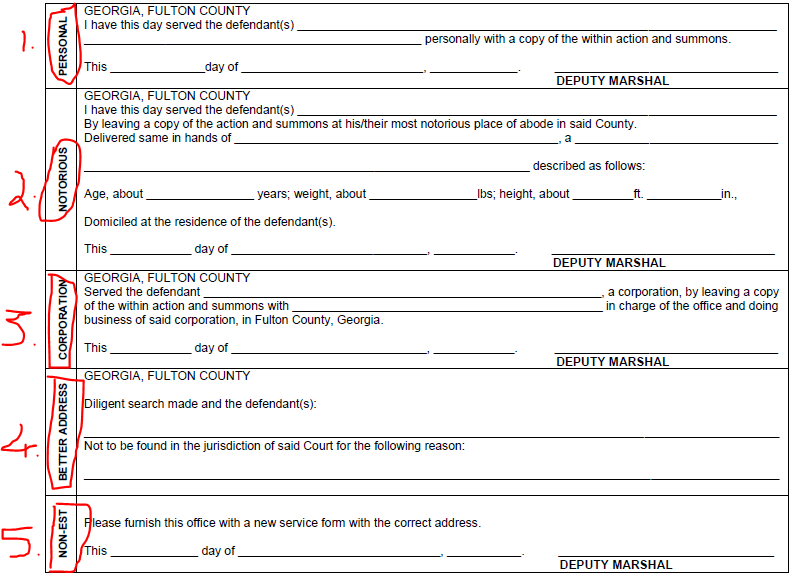
Service usually begins by providing the sheriff a copy of the complaint, summons, and sheriff’s entry of service form. Service by the sheriff typically takes two to three weeks, during which time a sheriff’s deputy will complete the form and mail it back to the filing party. What does this form mean? Below is the relevant part of the form and how we address the various types of service in our office:

If the “personal” box is completed (box # 1 above), almost always, the sheriff has handed the paperwork to the opposing party and service is complete. Now we can get to work on the case.

If the “notorious” box is checked (box # 2 above)  this means the sheriff has handed the paperwork to someone over 18 years old who lives the opposing party. Georgia law allows notorious service, but, in our experience, we should be cautious in these situations because notorious service is sometimes unreliable and can challenged. Fortunately, an answer is due from the opposing party 30 days after service. If service isn’t contested in the answer, we no longer need to worry about service. If service is contested in the answer and seems reasonable, we will discuss with you the merits of repeating service. Ultimately, getting proper service is important because if we don’t have proper service, any judgment we obtain might be overturned.

The “corporation” box  (box # 3 above) obviously applies to serving a corporation. If this is checked, generally, this ends up being successful service.

If the “better address” box is checked (box # 5 above)  this means the person living at the address provided has told the sheriff that opposing party has moved.

Finally, the dreaded “non-est” box  box # 5 above): this means the sheriff has gone to the address provided but was unable to serve the defendant. Most importantly, this means the lawsuit can’t continue. At this point, we need to determine if we have a good address for the opposing party. A defendant can be served at home, work, church, etc. If we are confident we have a good address despite the sheriff being unsuccessful, we recommend hiring a private process server. Unlike the sheriff, a private process server will work with us and has a much better chance of successfully serving the defendant. The cost for a private process server is about $100, but goes up depending on difficulty. If we aren’t confident that we have a good address, we recommend hiring an investigator to find a good address for the defendant. This is more expensive and will cost $250 and upwards.

If we still can’t find the defendant or believe the defendant is avoiding service, we’re entitled to ask the court to allow us to serve the opposing party by publication. We’ll address service by publication in a separate blog.

We hope this gives you a better idea regarding service of a lawsuit in Georgia. If you have any questions, please don’t hesitate to call us at 404-382-9994.

Foreclosure Confirmations: True Market Value Revisited

Conyers 138, LLC et al. v. ONH1, LLC, A17A0145, June 2, 2017, concerns the unique Georgia proceeding that allows foreclosures to be retroactively confirmed by petition in Superior Court. The purpose of a confirmation is to verify the property sold at foreclosure for the fair market value, thereby permitting the lender to sue the borrower to recover the difference between the loan amount and the amount at foreclosure. If the property sells for less than fair market value at the foreclosure, then the lender can’t pursue a deficiency claim against the borrower.

In Conyers 138, LLC, the lender’s appraiser testified the market value of the property was $2,510,000, but to arrive at the fair market value, he subtracted $765,000 for demolition because he contended the best use of the property was as raw, vacant land. The borrower argued that estimate of the demolition cost was inflated because the demolition company used a faulty methodology. The Court of Appeals rejected this argument, stating disputes such as which methodology to apply are factual disputes best evaluated and decided by the trial judge. “The trial judge is the judge of credibility of the witnesses and of the weights to be given to the evidence.” (citations and punctuation omitted).

Since there was some evidence presented that supported the trial court’s decision, the Court of Appeals refused to disturb the trial court’s ruling. The takeaway is that the trial court has a lot of leeway and that it’s an uphill battle to successfully appeal a trial court’s decision in a foreclosure confirmation proceeding.

Rape and Assault Cases in Georgia

Criminal Attacks are Happening More Frequently and Many Perpetrators Are Not Prosecuted or Go to Jail

In 2011, U.S. residents age 12 or older experienced an estimated 5.8 million violent criminal attacks, according to a report released by the Justice Department’s Bureau of Justice Statistics. These estimates are based on data from the annual National Crime Victimization Survey. Even worse, many of these criminals committing rape and assault do not go to jail. In fact, out of 1,000 sexual assaults, 975 perpetrators will walk free. And out of 1000 assault and battery crimes, 959 will never be charged with a felony. 

Criminal Attacks are Preventable

Rape and assault attacks often occur at apartment complexes, restaurants, hotels, and other businesses. These businesses, which invite you onto their property and profit accordingly, have a legal responsibility to provide a safe environment for their customers. And a responsibility to prevent crimes that are predictable. 

Inadequate Security

Many crimes result from business owners providing inadequate security for their customers. In these situations, a crime victim has a civil claim for damages against the business.

To establish liability in Georgia for inadequate security against a business, an injured party must show that the business owner has breached a duty “to exercise ordinary care in keeping the premises and approaches safe.”

Concerning criminal attacks, the business owner’s duty extends only to foreseeable criminal acts. In Sturbridge Partners v. Walker, 267 Ga. 785 (1997), the Supreme Court of Georgia “laid to rest the artificial notion that a crime against a person could never be foreseen by previous crimes against property” and, instead, provided more flexible guidelines for determining whether a crime is foreseeable. A crime is foreseeable if there have been similar prior crimes and the business owner has failed to act to prevent such crimes. 

Prior Criminal Attacks

To determine whether previous criminal acts are similar, the court must inquire into the location, nature, and extent of the prior criminal activities. While the prior criminal activity must be substantially similar to the particular crime in question, that does not mean identical. What is required is that the prior crime is sufficient to attract the business owner’s attention to crime. 

For example, are two previous burglaries enough to create the foreseeability of a rape at an apartment complex? Sturbridge concluded that the previous burglaries did create foreseeability because, although the burglaries “were committed when the apartments were vacant, it was reasonable to anticipate that an unauthorized entry might occur while an apartment was occupied and personal harm to a tenant could result.”

Rape and Assault Resources

If you are the victim of rape or assault, you are not alone. Here are some links to organizations that will help you free of cost. This is not something you want to go through without help–so please call!!!

http://www.safehorizon.org/index.php

http://www.summitadvocates.org/

http://www.callforhelpinc.org/

http://www.victimsofcrime.org/home

Georgia Crime Victims Compensation: See post.

Call Us!

In rape and assault cases in Atlanta and Georgia, it is critical to obtain records from all prior crimes that occurred where the crime occurred. At Gomez & Golomb LLC, we have been handling these cases for over 20 years. Please call 404-382-9994 to speak with an attorney.

Car Accident Statements

The insurance company asks for a recorded statement in almost every car accident case. The insurance adjuster will say the insurance company needs or requires a recorded statement to investigate the collision. Beware! This is a trap! You should never voluntarily agree to give such a statement following a car wreck.

In this blog, we consider when and under what circumstances (if any) to give a recorded statement to an insurance adjuster. One approach (paraphrased from Winston Churchill) is “Never, ever ever ever ever [voluntarily give a recorded statement to an insurance company].”

If your claim for a car accident is against another party’s insurance company (also known as a third-party claim), our policy is never to give a recorded statement. If the claim is against your own insurance company (for example, in an uninsured motorist claim), we are contractually obligated to give a statement to the insurance company describing the collision.

In our experience, the actual (and only) purpose of a recorded statement is for the insurance companies to find reasons to deny the claim or pay less for your injuries. Just like criminal lawyers tell their clients not to say anything (remain silent), the same applies in injury cases. The less said, the better.

As mentioned above, when the other party does not have insurance, and we are making an uninsured motorist claim, we must follow the terms of the insurance policy, which include giving a recorded statement. These are called examinations under oath (EUOs). We spend significant time preparing our clients for the recorded statement in these situations.

If we must give a recorded statement, we request a copy of the recorded statement. We read the following before every recorded statement: “This statement is being given for the sole purpose of providing [name of insurance company] and its adjuster, [name of adjuster], who is acting as an agent of its insured, [name of defendant], with information that may assist them in evaluating and compromising this claim.  This statement is given under OCGA § 24-4-408(b). Everyone agrees that this statement is not evidence, nor is it discoverable or admissible at trial including impeachment, should this claim proceed to litigation.”

If you are ever in a situation where you are being asked to give a recorded statement in an injury case, please consider calling us to discuss your options.

Automobile Injuries in Georgia

Throughout Atlanta, hundreds of car accidents occur every day. Our law office, Gomez and Golomb, has helped clients recover damages for automobile injuries caused by collisions since 1994.

Gomez & Golomb Will Maximize Your Automobile Injuries

Many lawyers try to handle automobile injury cases, but, unfortunately, many don’t handle these cases regularly, or only to get minimal settlements, or have paralegals or assistants do all the work. You see these lawyers smiling on billboards throughout town. Our office is different: we work super hard to maximize the recovery in each automobile injury case, whether $5,000 or $five million. Every case we take is equally important to us. And every case is handled by an attorney from start to finish. The insurance companies only offer top dollar for automobile injuries when they know the other side is competent and prepared to fight.

Automobile Injuries are a Big Deal

Being involved in a collision is a life-changing, traumatic experience. Car accidents often occur through no fault of your own. When a four, five, or six thousand pound vehicle hits your vehicle, even a low-impact collision will cause injuries. These include rear-end wrecks, failure to yield, and intersection wrecks. Collisions cause severe and sometimes permanent injuries.

Automobile Injuries Involve Complicated Legal Issues

Car wrecks in Atlanta involve several issues, including insurance laws, overlapping jurisdiction, and other complex legal issues. Correctly interpreting the law and advocating your position is vital to recovering the total amount of damages caused by the automobile accident. Damages for car accidents include property loss, medical costs, lost wages, and past and future pain and suffering. Insurance companies are for-profit businesses. Their goal, and the way they make profit, is to settle your car collision case for as little as possible. If you hire Gomez & Golomb, you will level the playing field and maximize your settlement.

Call Us!

If an automobile collision causes injuries to you, call us at 404-382-9994 to speak to a lawyer about your case.