

In Georgia, can a security interest in real estate expire?

Yes. A security interest in real estate expires (in other words, become unenforceable) seven years after expiration of the maturity of the debt. Or, if the language in the security deed contains an affirmative statement with the intent of establishing a perpetual security interest, then the expiration date is the later of (a) seven years from the maturity of the debt or (b) 20 years from the date of the conveyance. See O.C.G.A. § 44-14-80(a).

If a security deed expires based the above paragraph, the property reverts back to the borrower. This means the lender loses its security interest in the property and cannot foreclose.

An additional consideration is what happens if the loan is extended. O.C.G.A. § 44-14-80(b) answers this: as long as the loan is extended before the seven or 20 years—and, importantly, the extension is recorded on the public record—then the security interest is also extended by seven or 20 years (depending on the language in the security deed).

The import of recording an extension was the subject of a recent Georgia appellate decision. Bell v. Freeport Title & Guaranty, A20A0133 (May 1, 2020). In Bell, the loan and security went into default in 2007. However, the borrower signed two extensions. These extensions were never recorded on the public record. The lender foreclosed on the loan in 2015. The Georgia of Court of Appeals ruled that because the two extensions were not recorded, the lender’s security interest expired in 2014. Thus, the reversion of the property back to the borrower in 2014 voided the 2015 foreclosure.

Although mentioned in a footnote, Bell makes an important point, which is the grantee (here, the lender) has the duty to record its deed. Reidling v. Holcomb, 225 Ga. App. 229, 230-231 (1997). By failing to record the extensions, the lender had no one to blame but itself.

Please call Gomez & Golomb at 404-382-9994 if you have any questions about title to your property.
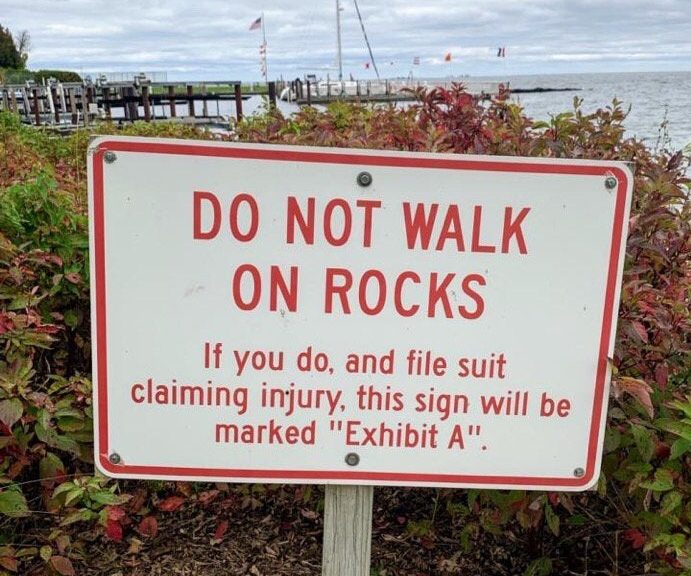

What is assumption of the risk and why is it important in a negligence case?

Insurance companies and defendants use assumption of the risk, a legal doctrine, to try to deny injury claims. The doctrine holds that if a person is aware of a dangerous condition, they should not ignore the risk. The above sign is a clear cut example: if you walk on the rocks and are injured, you cannot blame the landowner.

Most would agree we should be responsible for the consequences of voluntarily participating in activities we know are risky. But what happens when a landowner puts up a sign on their property saying: “be careful where you step because we are not responsible for any injuries.” If you are injured on the property, can the owner rely on its warning?

In Georgia, assumption of risk applies when the person injured (1) had actual knowledge of the danger; (2) understood and appreciated the risks associated with such danger; and (3) voluntarily exposed himself to those risks. Daly v. Berryhill, S19G0499 (2020).

How is this decided? While each case has unique facts, a court will look at whether the evidence shows the person knew of the specific risk of harm associated with the activity that caused injury, yet proceeded anyway. If there is a warning sign, like the one above, you are going to lose. If there was a general warning or no warning, but using common sense might have disclosed the risk, then it is a closer question.

An example would be someone who goes skiing assumes the risk they will fall and break a bone. If this happens, they cannot sue the ski resort for such an injury. On the other hand, if the ski resort failed to properly maintain a path down the mountain, but had warned that the path might be dangerous, then successfully suing the ski resort depends on whether the skier was aware of the particular risk.

If you have an injury case that involves negligence and assumption of the risk, please call us so we can explain your options.  

How To Successfully Foreclose the Right to Redeem Following a Tax Sale

Tyner v. Edge, which was decided by the Georgia Court of Appeals on May 22, 2020 (A20A0265), provides guidance on the process of foreclosing the right of redeem following a tax sale.

The court clarifies several aspects relating to properly barring the right to redeem:

(1) With regard to foreclosure of the right to redeem, Georgia law holds that a party who owns “any right, title, or interest in or lien” on the subject property is entitled to redeem (see O.C.G.A. § 48-4-40). Therefore, because of the word “any,” even a party with an unrecorded interest is entitled to redeem a property lost at a tax sale.

(2)  A party’s failure to record its interest does, however, have consequences because the holder of an unrecorded interest is not entitled to get a notice of foreclosure of the right to redeem. See OCGA § 48-4-45(a)(1)(c) and Freeman v. Eastern Sav. Bank, 271 Ga. 439, 440 (1) (520 SE2d 902) (1999). This means a tax deed holder can successfully bar the right to redeem without notifying persons or entities not in the chain of title. For this reason, a title search and careful examination of the title search is necessary in all cases.

(3) Regarding service by publication, the court confirmed that if the name and address of an interested party can be reasonably ascertained, notice of a tax sale by publication does not meet the requirements of due process. Hamilton v. Renewed Hope, Inc., 277 Ga. 465, 466 (589 SE2d 81) (2003). Consequently, tax deed holders must make a reasonable effort to locate all interested parties to successfully complete a barment, and cannot simply rely on publication.

(4) Payment of taxes, in and of itself, does not create an interest in property sufficient to trigger the notice requirements mentioned above. Thus, in this case, the party trying to redeem, who was not in the chain of title but had paid taxes, was not entitled to receive a barment notice.

Here, the tax deed owner won and the party trying to redeem lost. However, all parties who deal with tax deeds in Georgia can learn from this case. If you own a tax deed and need a lawyer, please call us at (404) 382-9994 to discuss barring the right to redeem for your tax deed.

The Actual Tax Sale in Georgia

As a general rule, tax sales are held on the first Tuesday of the month. However, not every county has a tax sale every month. Generally, the tax sales are conducted between the hours of 10 am and 4 pm  on the steps of the county courthouse. If the first Tuesday of the month falls on a legal holiday, the sale is held the next day, Wednesday.

The opening bid for a particular property is the amount of tax due, plus penalties, interest, fi. fa. cost, levy cost, administrative levy fee, certified mail cost, advertising cost, and tax deed recording fees. The property is sold to the highest bidder.

Immediately following the conclusion of the tax sale all purchasers must pay in full the amount bid at the auction. Payment must be in the form of cash, certified check, or cashier’s check. Normally, the purchaser to sign a statement attesting to the fact that certain property was purchased for a certain price. After all payments are processed, the count will provide a Tax Deed and the Real Estate Transfer Tax form.

According to O.C.G.A. § 9-13-170, any person who becomes the purchaser of any real or personal property at any sale made at public outcry who fails or refuses to comply with the terms of the sale when requested to do so, shall be liable for the amount of the purchase money. It shall be the county’s option either to proceed against the purchaser for the full amount of the purchase money or to resell the real or personal property and then proceed against the first purchaser for any deficiency arising from the sale.

Investa Services of GA, LLC: Tax Sale Case

Anyone who deals with excess tax sale funds or tax deeds in Georgia knows that Investa and/or affiliated entities play a significant role with regard to tax sales. Plaintiffs filed a class action against, among others, Investa. In this lawsuit, Investa was accused of improperly levying on tax executions for delinquent property taxes. The initial tax assessments were later reduced via a property tax appeal.

The trial court dismissed the lawsuit and Investa appealed. See B.C. Grand, LLC v. Investa Services of GA, LLC, A19A1297 (GA Ct of App, October 29, 2019). On appeal, the court ruled in favor of Investa et al., finding that B.C. Grand “failed to allege that the [Tax] Commissioner cancelled the tax executions or that they are void as a matter of law based on the post-issuance reduction in the tax assessment.” Because B.C. Grand failed to pay the taxes at issue while pursuing its appeal of the assessment. Instead, it waited to receive a refund (which it did receive), the full amounts owed remained valid. B.C. Grand also failed to plead the executions were void as a matter of law. So Investa was authorized to levy the executions at the full purchase price amount. Chalk one up for Investa.

New Georgia Supreme Court Ruling Limits Appellate Review of Jury Verdicts

The Georgia Supreme Court decision in Rockdale Hospital, LLC v. Evans clears the way for trial courts, without much in the way of appellate review, to retry cases if the judge believes the jury got it wrong. S18G1189, S18G1190 (October 7, 2019).

The case at issue involved a medical malpractice lawsuit in which a jury awarded $1.1 million dollars to for the injured party’s past medical bills, but zero damages for future medical expenses, past and future lost wages, and past and future pain and suffering. The injured party appealed to the Georgia Court of Appeals, arguing that awarding zero damages for pain and suffering was “clearly inadequate” based on the $1.1 million award for past medical bills. The Georgia Court of Appeals agreed the verdict was “clearly inadequate,” and instructed the trial court to retry the case. The decision makes sense because it seems impossible to have $1 million of medical treatment without, at the same time, experiencing significant pain and suffering.  

The Georgia Court of Appeals’ decision was appealed to the Georgia Supreme Court (the highest court in Georgia). The Georgia Supreme Court disagreed with the Georgia Court of Appeals and overruled its decision. The Georgia Supreme Court decided that whether or not to retry a case is almost always up to the trial judge, not the appellate courts. As long as the trial judge reasonably exercises his or her discretion, the appellate courts must go along with the judge’s decision regarding whether a jury verdict was clearly excessive or inadequate. The reasoning is that trial judges personally observed the witnesses and evidence, and are therefore in the best position to evaluate jury verdicts. The Court concluded that appellate courts have authority to set aside jury verdicts only when the verdict is so irrational as to be the obvious result of bias, corruption, or prejudice; this is characterized by the Court as an “extremely high” threshold. In other words, in most cases, appellate courts lack authority to review a trial court’s decision on this issue.

We’ll have to see how this ruling plays out, but in theory the decision cuts both ways because it potentially impacts both small and large verdicts. The takeaway is that in most instances, trial judges now get to decide if the verdict was too large or too small with little oversight from the appellate courts.

Georgia Easement Disputes

For those interested in easements disputes, a new case from the Georgia Court of Appeals is worth reviewing. Patel Taherbhai, Inc. v. Broad Street Stockbridge, LLC, A19A0820 (October 3, 2019). This case involves adjoining landowners, Patel and Broad Street, who got into a dispute regarding an easement. The easement was on Patel’s property and allowed Broad Street to go over Patel’s property to reach a public street.

Broad Street complained that Patel was blocking access to the easement. After back and forth between the parties’ attorneys, Broad Street filed an ejectment lawsuit against Patel. The lawsuit alleged Patel had constructed improper and unsafe encroachments on the easement. These were denying Broad Street access and diminishing the value of its property. Therefore the encroachments should be removed. Patel denied the alleged encroachments were blocking access. And, even if access was being blocked, Broad Street had consented to the encroachments by failing to timely object.

The trial judge agreed with Broad Street and ordered the encroachments ejected (i.e., removed) from the easement. Broad Street appealed. The appellate court’s analysis focused on whether a party is entitled to file an ejectment lawsuit to remove an encroachment from an easement. In a well-reasoned decision, the appellate court determined that ejectment cannot be used in these situations. Instead, ejectment only applies when a party’s rightful possession to its property is being denied. Here, Patel’s alleged misconduct wasn’t occurring on Broad Street’s property (instead, it was occurring on Patel’s property) and therefore Patel wasn’t interfering with Broad’s Street’s possession of its property. This does not mean Patel is off the hook, only that the correct remedy is these cases is to file an action for damages and/or an injunction.

While many appellate decisions unfortunately provide little guidance, this thoughtful decision arrives at a ruling by carefully examining prior case law (going back to the 1800’s) and opinions expressed by real estate experts. In the end, lawyers (and landowners) now have a definitive understanding of how to handle situations in which an adjoining neighbor blocks an easement.

If you’re in a real estate dispute, please contact us for a free evaluation. Our number is (404) 382-9991.

TAX DEED LEGAL SERVICES: Helping You Secure Clear Ownership

If you’ve acquired property through a tax deed in Georgia, we offer two essential legal services designed to help you protect and perfect your ownership: (1) Foreclosure of the Right to Redeem and a (2) Quiet Title Action.

1. Foreclosure of the Right to Redeem

Overview

In Georgia, you are eligible to begin the process of foreclosing or barring the right to redeem the property one year after the tax sale. This legal step permanently terminates the rights of the prior owner and other interested parties to reclaim the property.

Notification Process

You must notify the individual who owned the property at the time of the tax sale, along with any other parties holding a legal interest. A full title search is required to identify these parties. Notice must be given both directly and through legal publication. After these steps, an affidavit of barment is filed with the court to finalize the process.

Our Fixed Fee

We typically charge a fixed fee of $3,250, which includes most standard out-of-pocket expenses. This covers the title search (approximately $350), publication (around $250), sheriff’s service (about $50 per service), and certified mailings (approximately $6.80 per envelope).

In cases where the prior owner is deceased, we must identify and locate all heirs, which may require additional time and cost. If this applies to your case, we will consult with you to assess the additional work required.

2. Quiet Title Action

Overview

After foreclosing the right to redeem, a quiet title action is often necessary to obtain full, marketable title. This process eliminates any remaining claims and allows you to sell, develop, or finance the property confidently.

Legal Procedure

A quiet title action is filed in the Superior Court of the county where the property is located. The court appoints a special master—an independent attorney—who reviews the case and submits a recommendation to the judge regarding the legitimacy of the title.

Fees and Estimated Costs

Our attorney’s fees for quiet title actions are billed at $400 per hour. In most cases, the legal work required amounts to approximately $2,500. The fee for the court-appointed special master is typically $2,500, and court costs—such as filing fees and service of process—are usually around $1,000.

Altogether, the total average cost of a quiet title action is approximately $6,000, depending on the complexity of the case.

Ready to Move Forward?

We’re here to help you through every step of the process—from initial notice to full title clearance. For a consultation or to begin service, please contact our office directly at 404-382-9994.