Important Georgia Excess Tax Sale Funds Case: Home Equity Credit Series 2021 v. Patrick Labat

Facts

In a well-reasoned and clearly articulated opinion dated April 17, 2025, the Georgia Court of Appeals clarified the rights of parties claiming excess funds following a tax sale. In Home Equity Credit Series 2021 v. Patrick Labat, a tax sale held on February 1, 2022, generated $438,598.95 in excess funds. The property was later redeemed on behalf of the owner, Nelson, by mortgage servicer NewRez (acting through its agent, CoreLogic) for $528,000.

The Fulton County Sheriff subsequently filed an interpleader action to determine the rightful recipients of the excess funds. Claims were filed by: NewRez, seeking $276,763.71 to satisfy a mortgage payoff as servicer for Freddie Mac; Georgia Housing and Finance Authority (GHFA), claiming $6,833.22 based on a subordinate security deed; and Home Equity Credit, claiming entitlement to all remaining funds based on an assignment of rights from Nelson.

At a hearing,  trial court awarded: $276,763.71 to NewRez, $6,833.22 to GHFA, $151,014.46 to another lienholder, $3,987.56 to the Sheriff for costs. Home Equity Credit received nothing and appealed.

Key Legal Issue

The central legal question on appeal was whether holders of security deeds are entitled to excess tax sale funds under OCGA § 48-4-5, or whether their claims are limited to interests in real property only, and therefore excluded.

Home Equity Credit contended that NewRez and GHFA were ineligible to receive any excess funds as their interests were limited to real estate, not personal property. They relied primarily on two cases: DLT List, LLC v. MM7VEN, 301 Ga. 131 (2017), which held that excess tax sale funds are personal property and cannot be claimed by parties whose interests attach only to the real estate; and Jackson v. Wellington & Assoc., 389 F. Supp. 3d 1199 (N.D. Ga. 2019), where a federal court went further, suggesting that security deed holders are not entitled to such funds.

Court of Appeals Ruling

The Court distinguished Jackson as non-binding federal precedent and emphasized the plain language of OCGA § 48-4-5(a)-(b), which requires notice to “record owner[s] of each security deed” and directs the superior court to distribute excess funds “to the owner or owners as their interests appear.”

Additionally, citing OCGA § 44-14-60, the Court noted that holders of security deeds retain actual legal title and are considered “owners” under Georgia law. The Court therefore found that the Georgia Legislature clearly intended for such parties to receive excess funds in line with their lien priorities.

Conclusion

The Georgia Court of Appeals affirmed the trial court’s distribution of excess funds and held that security deed holders are eligible recipients under OCGA § 48-4-5. The Court declined to follow contrary federal authority and reaffirmed the rights of lienholders to claim excess funds based on their recorded interests.

Call Us

If you have questions, do not hesitate to call us at 404-382-9994.

Georgia Case Regarding Lis Pendens and Slander of Title

Notice of Lis Penedes

Understanding Lis Pendens in Georgia Real Estate Law

A lis pendens is a legal notice recorded in the county where a property is located, alerting the public that a lawsuit has been filed involving that property. It serves to notify prospective buyers or lenders that the property is the subject of litigation and that the outcome may affect any interest they acquire. In Georgia, the controlling statute is OCGA § 44-14-610.

Crucially, a lis pendens cannot be based solely on a claim for monetary damages. Its function is to warn that the lawsuit seeks specific relief affecting the property itself. As explained in Evans v. Fulton Nat’l Mtg. Corp., 168 Ga. App. 600, 309 S.E.2d 884 (1983), the litigation must involve a direct interest in the property for a lis pendens to be valid.

Example

If a fraudulent deed is recorded, and the rightful owner files suit to challenge it, the owner can also record a lis pendens. This ensures any would-be buyer is on notice of the dispute. Should a buyer proceed with the purchase despite the notice, they are bound by the lawsuit’s outcome and could lose the property if the plaintiff prevails.

Case Study: Spinola v. Akaranta

In this recent decision, Spinola sued her neighbor, Akaranta, claiming that a water leak from Akaranta’s condominium caused damage to her own unit. Spinola sought monetary damages and also requested an injunction to prevent Akaranta from selling her unit. She recorded a lis pendens against Akaranta’s property to notify potential buyers of the ongoing litigation.

Akaranta counterclaimed, asserting that the lis pendens was improperly filed and had defamed her title, causing a sale to fall through and preventing her from purchasing another property. Initially, the trial court declined to cancel the lis pendens, based on weak property-related claims by Spinola (such as the assertion of a constructive trust). Although the court later reversed that decision and ruled the lis pendens improper, the initial ruling gave Spinola leverage, despite her ultimately admitting that her claims only involved damage to her own unit.

At trial, the jury found that Spinola had wrongfully filed the lis pendens, harming Akaranta by interfering with the sale of her property. The jury awarded damages and attorney’s fees to Akaranta.

However, the Georgia Court of Appeals reversed the verdict. The Court held that, under OCGA § 51-5-8, statements made in connection with judicial proceedings—including those in recorded documents like a lis pendens—are privileged if they are pertinent to the relief sought, even if ultimately found to be false or unsupported. Because Spinola’s lis pendens was filed as part of a legal proceeding and related (at least nominally) to property claims, it was protected by this statutory privilege. As a result, it could not form the basis for a slander of title or defamation claim.

Legal Takeaway

To prove slander of title under OCGA § 51-9-11, a plaintiff must show the publication of false, malicious statements that caused special damages. But when the statement is protected by privilege—as with a lis pendens filed in a pending lawsuit—it cannot support a defamation claim, regardless of the filer’s intent or the document’s eventual rejection by the court.

In Spinola, the effect was that although the jury determined the lis pendens was improperly recorded and caused real harm, the damages were overturned due to the legal protections afforded to court-related filings. The case underscores the importance of correctly filing a lis pendens and understanding the legal privileges attached to litigation-related documents.

Questions?

If you need legal guidance about lis pendens or any related real estate dispute, don’t hesitate to contact our office at (404) 382-9994.

Excess Tax Sale Funds in Georgia: A Quick Review

Property

In Georgia, properties can be auctioned if the owner fails to pay property taxes. When a property is sold at a tax sale for more than the amount owed in taxes, the remaining funds are considered excess funds. These funds are typically held by the county tax commissioner’s office or the sheriff. The Georgia statute that addresses excess tax sale funds is OCGA § 48-4-5.

How long do you have?

Excess funds will be maintained for five years from the date of sale under OCGA § 48-4-5(c) before being turned over to the Georgia Department of Revenue, Unclaimed Property Division.

Who is Entitled to Excess Funds?

Generally, those who may be entitled to claim excess funds include:

  • The property owner at the time of the tax sale: If the property owner can prove ownership and has not relinquished their rights, they may be entitled to the excess funds.
  • Lien holders: Mortgage companies or other lien holders with a recorded interest in the property at the time of the tax sale may also be entitled to claim the funds.
  • Other interested parties: In some cases, other parties with a legitimate interest in the property may be able to claim excess funds.

Excess tax sale funds are paid first to lienholders with a recorded interest on the day of the tax sale (in the order the interests were recorded) and then to the property owner at the time of the tax sale.

Claim Process

Claiming excess tax sale funds can be a bureaucratic and frustrating process. It involves providing documentation to prove ownership or interest in the property and filing a claim with the county tax commissioner’s office. The specific requirements and procedures vary by county.

Claiming excess tax sale funds can be challenging for several reasons:

  • Documentation requirements: Proving ownership or interest in a property can be difficult, especially if the property has changed hands multiple times or records are incomplete.
  • Bureaucratic hurdles: Like many government agencies or large corporations, filing a claim can be time-consuming and frustrating, with unnecessary bureaucratic obstacles.

If you are entitled to excess tax sale funds, here are some tips:

  • Act promptly: Research the time limits for filing claims in your county and act quickly.
  • Gather documentation: Collect relevant documents, such as deeds, mortgages, and property tax records.
  • Consult an attorney: An attorney can help you navigate the legal process and protect your rights.

Would you like to know more about a specific aspect of excess tax sale funds in Georgia, such as the time limits for filing claims or the documentation required? Please call us at 404-382-9994; we’ll happily answer any questions.  

Quiet Your Title Worries: Overview of Marketable Title in Georgia

Types of Property Tax

Owning property in Georgia is a dream for many, but title issues can turn that dream into a nightmare. If you’re facing a cloud on your title – a potential claim that could prevent you from selling or refinancing your property – a quiet title action can be the solution.

Marketable Title

Marketable title is a legal term that refers to a property title free from any claims or disputes that could reasonably be expected to affect its value or ownership. In essence, it’s a title that a prudent buyer would be willing to accept.

What is a Quiet Title Action?

A quiet title action is a lawsuit allowing you to clear up doubts about the property’s rightful owner. By filing a quiet title lawsuit, you’re asking the court to declare you the owner and “quiet” any challenges to your title.

Types of Quiet Title

There are two types in Georgia: (1) conventional and (2) against all the world. Conventional is used when you must cancel a particular deed that is clouding your title. Against all the world is used when unknown persons may own your property. An example of a conventional type is if someone filed a fraudulent deed against your property, while an example of an against the world type is if you find out the person who sold you your property did not have full title; if you can’t find that person, you must file a quiet title against all the world.

Why Would I Need a Quiet Title Action in Georgia?

You might need a quiet title action in Georgia for several reasons. Here are a few common ones:

  • Heir Property: If you inherited property and there are questions about the validity of the will or the rights of other heirs, a quiet title action can help solidify your ownership.
  • Boundary Disputes: Unsure exactly where your property line ends? A quiet title action can help establish the legal boundaries of your land.
  • Tax Sales: A quiet title action is normally needed to clear the title following a tax sale.
  • Errors in Public Records: Mistakes on deeds or other public records can create clouds on title. A quiet title action can correct these errors.
  • Fraudulent Deeds: If someone fraudulently (or unintentionally) records a deed that shows up in your chain of title (the deeds that show you own the property, a quiet title is needed.
  • Uncancelled Loans: If you use your property as collateral to get a loan (i.e., a mortgage), the lender places a security deed on your property. Once you pay off the loan, the lender is supposed to cancel the security deed. Sometimes, for various reasons, the lender fails to cancel the security deed. For example, if a lender goes out of business, there may be no one to cancel the security deed.
  • Gaps in Ownership: When you sell your property, an attorney may call you to say that there is a gap in your ownership. For example if A sells to B and B sells to C, but you got your property from D, you have a title problem problem becuase you need a deed from C.

The Benefits of a Quiet Title Action in Georgia

A successful quiet title action provides several benefits:

  • Peace of Mind: Knowing your title is clear lets you relax and enjoy your property.
  • Increases Property Value: Properties with marketable title are more valuable than those with title issues.
  • Marketability: Without a clear title, you will likely be unable to sell your property.
  • Loan Approval: A clear title is essential for loan approval if you want to refinance your property.

The Quiet Title Process in Georgia

  1. Consult with a Real Estate Attorney: An experienced attorney can advise you on whether a quiet title action is right for you and guide you through the process.
  2. File a Lawsuit: The attorney will file a petition with the Superior Court in the county where the property is located.
  3. Serve Notice: The court will require that all potential claimants be served with the lawsuit.
  4. Special Master Appointment: In a quiet title against all the world, and sometimes in a conventional quiet title, the court will appoint a special master to investigate the claims and make recommendations.
  5. Court Hearing: The court or the special master will hold a hearing to determine property ownership.
  6. Judgment: The court will issue an order declaring the rightful owner. This order will then be filed on the county’s real estate records. Recording the court order gives you clear title.

Get Help With Your Quiet Title Action in Georgia

If you’re facing a cloud on your title in Georgia, don’t hesitate to seek help. We can advise you on your best course of action and ensure a smooth and successful quiet title process. Call us at 404-382-9994.

Quiet Title, Adverse Possession, and Color of Title

Quite Title Deeds

The title of this blog encompasses three differing but often overlapping areas of Georgia law. The Georgia Court of Appeals decided a case involving all three: quiet title, adverse possession, and color of title. See Brownphil, LLC v. Cudjoe, __ Ga. App. __ (March 14, 2024, A23A1762).

To understand the case, we have to quickly review the title history. The property was obtained by Earnest and Louise McClendon in 1958. They conveyed their interest to Grier Construction Company (owned by Freddie Grier). In 1997, Freddie Grier—not Grier Construction—conveyed the property to Cudjoe. Brownphil got involved when he got a quitclaim deed from Earnest and Louis McClendon’s heirs.

Brownphil filed a quiet title action to clear the title of the property, claiming that Cudjoe did not have an interest in the property because Grier Construction was not incorporated at the time it received the property from Earnest and Louise McClendon and because Freddie Grier—the party that granted the property to Cudjoe—was never on the title. Cudjoe argued that he obtained full title by adverse possession.

Interestingly, the special master appointed to the case sided with Brownphil. But, after a hearing, the trial court ruled in favor of Cudjoe.

An appeal followed in which Brownphil argued that Cudjoe had not done enough to establish adverse possession. After receiving a deed from Freddie Grier, Cudjoe paid the property taxes and mowed the lawn. Brownphil argued that paying taxes and lawn mowing are insufficient to gain title by adverse possession.

After reviewing the facts and prior cases, the Georgia Court of Appeals ruled in favor of Cudjoe. The Court of Appeals cited the legal doctrine of “color of title” as the main reason for favoring Cudjoe. Color of title means that someone has a writing (usually a deed) that appears to grant them title. When someone has color of title, importantly, they only have to show seven years of adverse possession and the element of “notoriety” usually required for adverse possession is waived. Notoriety means placing the world on notice that you adversely possess the property. Only having to show seven years and not having to establish notoriety makes it much easier to display adverse possession.

Based on this easier standard, the Court of Appeals found that Cudjoe had shown enough to obtain title to the property through adverse possession.

If you have any questions regarding a quiet title, adverse possession, or color of title, please call us at 404-382-9994.   
A No-Brainer (and Free!!) Way to Prevent Real Estate Fraud in Georgia

Count Twelve Fraud

Real Estate Fraud in Georgia

Real estate fraud in Georgia is alive and well. Folks filing fake real estate deeds in Georgia are common. And if you have ever encountered a sovereign citizen, you may have seen some interesting paperwork recorded on Georgia’s public record. Once an improper deed is recorded against your property, it is not always easy to remove and may require filing a quiet title action.

One easy way to combat real estate fraud in Georgia is to register your name with the Georgia Superior Court Clerks Cooperative Authority (“GSCCCA”). These days, most Georgia real estate deeds and documents are recorded using GSCCCA’s online portal. So, to combat fraud, the GSCCCA created a webpage titled the Filing Activity Notification System.

Filing Activity Notification System (a/k/a “FANS”)

To prevent real estate fraud, FANS is a system that allows individuals in Georgia to sign up and receive notifications whenever real estate and personal property records are filed, indexed, and transmitted by Clerks of Superior Court. You can get notifications for all Georgia counties or you can select just one county. So, for example, if someone files a fraudulent quitclaim deed in Bartow County using your name, you will get notified by email or text.

You can opt-in to this system by creating a notification request, which will send an email or text whenever a document in select official county records is filed and index data is entered and transmitted to the GSCCA by the Clerk. The system matches the notification criteria you set up when you register. Notifications are generated for a document filed and index data only for your established parameters.

Notifications

Notifications generated by the system depend upon the index data entered and transmitted by the Clerk of Superior Court in the county of filing. Therefore, it’s not guaranteed that the notices generated by this system will be comprehensive, but it costs nothing and is, therefore, a no-brainer to sign up. With being notified, you may completely unware of the real estate fraud.

Obviously, this system may not work well for you if your name is John Smith. But if your name is less common, like this blog’s author, this system is a great way to protect your real estate proactively. Even if your name is more common, you can limit the counties to only those where you own real estate.

Subdivision Easements in Georgia

Subdivision Easements in Georgia

Georgia Law Regarding Subdivision Easements

Georgia law grants subdivision homeonwers easements regarding certain features identified on subdivision plats, including streets, parks, and lakes. Such designations on a plat conveys an intent by the original developer to grant an easement to all lot owners in a subdivision.

Tucker v. Brannen Lake East

The Georgia Court of Appeals looked at this issue in Tucker et al. v. Brannen Lake East, LLC, A23A1265 (January 29, 2024). In Tucker, the dispute involved use of a lake in a subdivision. A homeowner purchased a lot in the subdivision next to a lake. At the time of purchase, neither the deed to the buyer, the subdivision plat, nor the lot survey showed any restriction related to use of the lake. After purchase, the homeowner used the lake with no issues until the lake owner (another property owner) told the owner that he could not use the lake.

The lake owner claimed an earlier deed to the homeowner’s property contained what is called a “restrictive covenant.” A restrictive covenant is language in a deed in which the seller limits the purchaser’s future use of the property. Here, the lake owner claimed that an earlier deed restricted use of the lake.

Court Decided Homeowner Could Use Lake Despite Alleged Restrictive Covenant

The Court of Appeals confirmed that Georgia law has long recognized that when a developer conveys lots concerning a subdivision plat, the buyers may receive easements in certain features—mostly streets and parks—designated on the plat. Usually, identifying an easement on the subdivision plat is enough, absent contrary evidence in the plat or deed, to grant an easement in the features to lot owners who bought with reference to the plat. Examples are streets, parks, and lakes (which are treated similarly to parks). So if a subdivision plat shows a park, arguably, everyone in the subdivision has an easement to use the park.

The Court explained that:

These features share two things in common with the first being that there is simply a well settled understanding, reflected in more than a century of our decisions, that when these basic features are designated on a subdivision plat, there is ordinarily no reason to doubt that they are included as part of the unified plan for the subdivision and meant for the lot owners’ use. Second, and equally important, these are the sort of features for which designation or delineation on the plat alone can give reasonable certainty about the scope of the easement granted. Simply put, settled expectations rooted in more than a century of practice and the relative ease with which the scope of an easement in these features can be discerned support a strong presumption that designating these features on a subdivision plat conveys an intent to grant an easement to lot owners who buy with reference to the plat.

(citation and punctuation omitted).

The guiding principle in the case is that with regard to restrictive covenants, the “legal presumption is in favor of the free use of the property by its owner, and any doubt will be construed in favor of the owner.” The Court examined the actual restrictive covenant in the earlier deed and determined that the deed had contradictory language. Therefore,

the seemingly contradictory language between the October 21, 1993 deed and the Summary of Conditions and Restrictions as to the property subject to those conditions and restrictions cannot justify terminating Tucker and Marsh’s use of the lake—especially in light of the Brannen Lake subdivision plat explicitly referenced in their 2015 deed.

If you have any questions about subdivision easements or restrictive covenants, call us at 404-382-9994 to discuss.

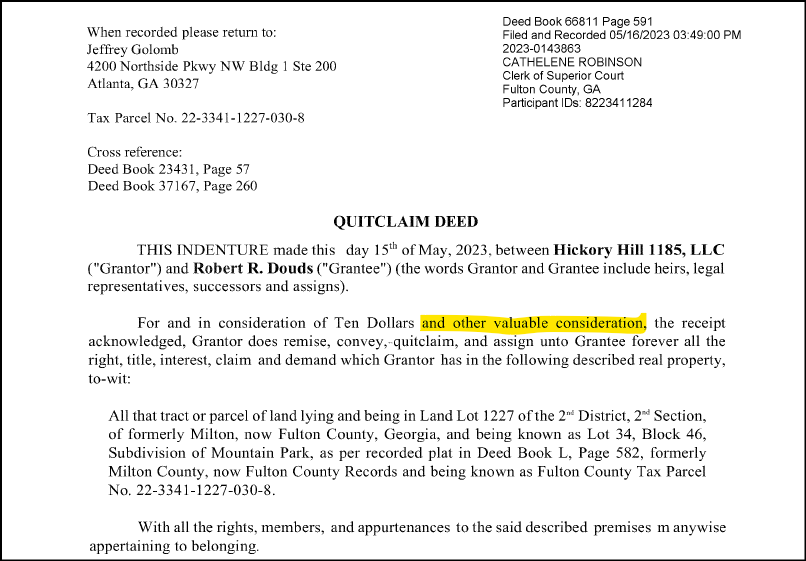
In Georgia, Parol Evidence Admissible When Deed Includes Phrase “Other Valuable Consideration”

Quit Claim Deed

If you have bought or sold real estate in Georgia (and elsewhere), you have certainly seen the “purchase price” described in most deeds as follows:

Grantor, in consideration of One Dollar ($1.00) and the purpose recited herein, in hand paid at and before the sealing and delivery of these presents, the receipt of which is hereby acknowledged, by these presents does remise, convey, and forever QUITCLAIM unto said Grantee, the below described tract or parcel of land more fully and completely described as follows …

But what does “For value received” or “Ten dollars and other valuable consideration” mean, why is it used, and why isn’t the actual purchase price included in the deed? The nominal amount of one dollar (or ten dollars) is included to satisfy the consideration requirement to make a deed enforceable. Consideration means payment: one dollar or ten dollars satisfies this consideration requirement. The author has looked into why this is done and believes buyers and sellers use this language to conceal the price paid for the property on the public record. These deeds are recorded and available to the public. Using one dollar or ten dollars as the purchase price makes it more difficult to know the actual purchase price. Although the transfer tax can often determine the purchase price, this is not foolproof and adds another layer for an inexperienced examiner. Regardless of why it’s done, this language is used in virutually all deeds, including quitclaim and warranty deeds.

This issue came up recently in an interesting case. Please see Schaffer v. Collinsville Meadow Townhomes, A23A1382 (January 24, 2024). In that case, a seller quitclaimed his interest in property for “One Dollar ($1.00) and other valuable consideration, receipt whereof is hereby acknowledged.” Of course, a dispute arose, which included the seller claiming he had not been paid for conveying the property via the quitclaim deed.

The issue relevant to this blog was whether the seller could sue the buyer for nonpayment when the quitclaim deed did not include an actual purchase price. The Court of Appeals ruled that because the deed included the language “other valuable consideration,” the seller could introduce evidence outside the quitclaim deed to establish the purchase price. Such outside evidence is known as parol evidence. Succinctly stated, the Court explained that

As our Supreme Court has explained, the manner in which consideration is expressed in the quitclaim deeds [the seller] conveyed is a classic example of consideration merely by way of recital; and as a result, the details of such consideration are properly subject to further inquiry.

If you have any questions or are in a dispute regarding a real estate deed in Georgia, please get in touch with us at 404-382-9994 to discuss.

Adverse Possession: How To Meet the “Public” Requirement

Adverse Possession in Georgia

To establish an easement by prescription, the party making such a claim has the burden of proof. The elements of prescription are (1) possession that is in the right of the party claiming possession and not another,  (2) possession that is public, continuous, exclusive, uninterrupted and peaceable, and (3) possession accompanied by a claim of right. OCGA § 44-5-161. Possession of property in conformance with these elements for 20 years confers good title by prescription to the property. OCGA § 44-5-163.

In a recent case, Talboy v. Dukes (__ Ga. App. __, October 4, 2023; A23A1068), the Georgia Court of Appeals examined the definition of “public” possession. The dispute in question revolved around an underground sewer line that extended into an adjacent property. The Court determined that the party seeking an easement could not establish public possession since the sewer line was underground and therefore not visible to the public.

In order to determine the meaning of “public“, the Court looked up its definition in the dictionary. According to Black’s Law Dictionary, the term “public” encompasses the definition of “notorious”. “Notorious possession” is defined as a type of possession that is so visible that it is generally known and discussed by the public or people in the surrounding area. Possession or the act of holding something that has such noticeable features that the owner may be presumed to have knowledge of it and its scope. This definition was taken from the 6th edition of Black’s Law Dictionary, published in 1990.

Applying this definition to adverse possession, the Court reasoned that the claimant could not show that the property was “so conspicuous that it is generally known and talked of by the public or the people in the neighborhood” or had “such elements of notoriety that [the Claimant] may be presumed to have notice of it and of its extent.”

The law regarding obtaining title to land by adverse possession can be abstract and confusing, but Talboy provides clarity regarding how to apply the requirement of public possession in the real world. Please call us at 404-382-9991 to discuss any questions you have about an easement or adverse possession.