
Declaratory Judgments in Georgia

Petition For Declaratory Judgment

New Georgia Supreme Court

What is a declaratory judgment? When is it helpful? When can it be used? These questions were answered by the Georgia Supreme Court in Cobb County v. Floam, __ Ga. __ (S24A0599, decided May 9, 2024).

Simply put, declaratory judgments are designed to provide legal guidance to a party uncertain about their future legal rights. For example, in a contract dispute, if parties disagree regarding the future performance of a contract term, either party may seek a declaratory judgment. A declaratory judgment is appropriate in this situation because a clear understanding of the parties’ future rights is necessary to help or protect the parties determine their future conduct.

Existing Georgia Statutory Law

By statute, the Georgia legislature instructs that Georgia courts are entitled “to declare rights and other legal relations of any interested party petitioning for such declaration” “[i]n cases of actual controversy” and “in any civil case in which . . . the ends of justice [so] require[.]” OCGA § 9-4-2(a), (b). The Georgia legislature further instructs a declaratory judgment “is to settle and afford relief from uncertainty and insecurity with respect to rights, status, and other legal relations[.]” OCGA § 9-4-1.

Yes, the above language is vague . . . even for attorneys. “Actual controversy” and “ends of justice” are not exactly objective measures. Since the above law was passed in 1946, Georgia courts have issued many decisions interpreting these laws, culminating in the most recent Georgia Supreme Court decision mentioned above.

Like a United States Supreme Court decision, when the Georgia Supreme Court tackles an issue, it creates a strong precedent that usually applies for many years. Thus, Floam is a significant case. Floam confirms that a declaratory judgment is appropriate only when it will “direct the plaintiff’s future conduct” but is not appropriate to decide already accrued rights. Floam explains that a declaratory judgment is not to resolve “academic debates or deciding purely theoretical questions” but only to offer “relief from the threat of wrongful acts and injuries yet to come.”

At issue in Floam was the Floams’ allegation that a recent redistricting in Cobb County was unconstitutional. In particular, the Floams claimed that they had voted for a specific commissioner before the redistricting but are now represented by a different commissioner.

The Takeaway

Applying the above analysis, the Supreme Court determined that the Floams claim had “no relation to any uncertainty as to their future conduct. The Floams frame their right as the right to be represented by the person for whom they voted. But any violation of such a right occurred once the BOC Amendment took effect, and the Floams have not alleged how that past violation creates uncertainty as to their future conduct.” Thus, while redistricting may or may not have been unconstitutional, the Floams could not obtain a declaratory judgment because they did not allege a possible future injury.

Floam concludes by warning that despite its ruling, the proposed redistricting in Cobb County will no doubt impact Cobb residents in the future. It explains that its decision is limited only to the facts presented by the Floams. Reading between the lines, the outcome likely would have been different had the Floams made a better argument, i.e., not being able to vote for the same commissioner was not persuassive.

Call Us!

While Floam involves government law, it provides valuable instruction for reaal estate and business disputes, where declaratory judgments can be critical. Please call us at 404-382-9994 with any litigation-related questions.

What is Negligence Per Se in Georgia?

What is Negligence Per Se in Georgia

Defintion of Negligence

Entire law school classes focus on negligence and its application, so this blog is a very general introduction to one of the negligence-related concepts called negligence per se.

Negligence is the failure to take proper care in doing something. The most common example is an automobile collision. No one intends to cause an automatable collision. But, if a driver isn’t paying attention and rear-ends another vehicle, such lack of care constitutes negligence.

Elements of Negligence

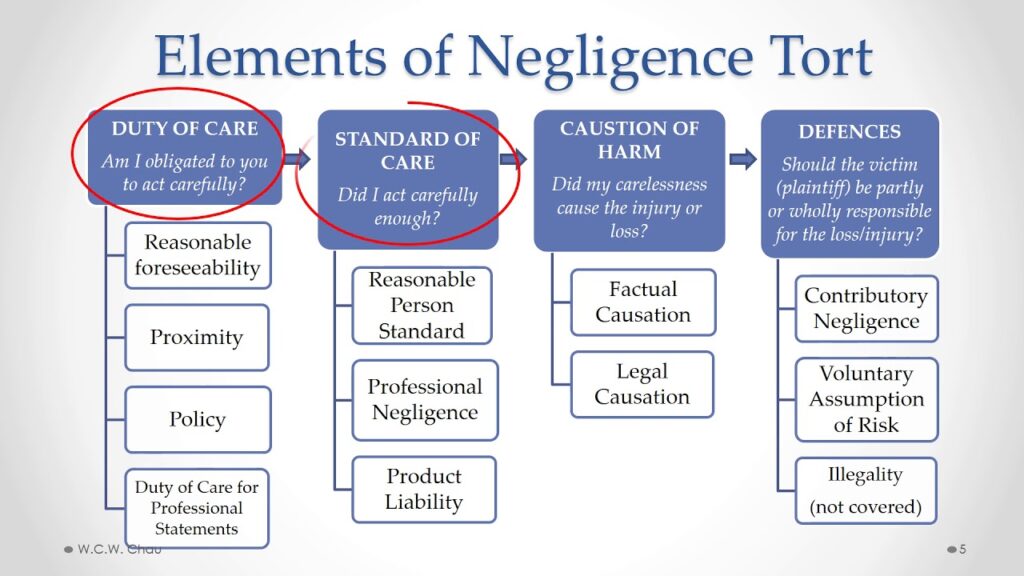
Four elements are required to establish negligence: (1) a legal duty that the defendant owed to the plaintiff, (2) a breach of that duty, (3) an injury, and (4) proof that the negligence caused the injury.

Negligence Per Se and Breach of Duty

So what is negligence per se? Under Georgia law, violating a statute, ordinance, or mandatory regulation may constitute negligence per se. To prove negligence per se, you must show a violation of a statute, that the harm complained of was the harm the statute was meant to protect against, that the person harmed fell into the class of persons the statute was intended to protect, and that the violation caused the injury. Gleaton & Associates, Inc., v. Cornelius, A22A1403 (February 8, 2023).

While not intuitive, negligence per se addresses the first element listed above: the legal duty owed. Lots of times, it isn’t clear whether someone has a duty to another person or what that duty consists of. With negligence per se, if a statute, ordinance, or regulation applies, violation of such a rule will satisfy the obligation to show a breach of a legal duty.

An Example of Negligence Per Se

In Gleaton, the case mentioned above, a tenant alleged the negligent filing of a dispossessory lawsuit against her. OCGA § 44-7-58 states that “[a]nyone who, under oath or affirmation, knowingly and willingly makes a false statement in an affidavit signed pursuant to Code Section 44-7-50 . . . shall be guilty of a misdemeanor.” The tenant alleged the landlord had violated that statute and was liable for negligence. Ultimately the court ruled for the landlord because it ruled the allegations in the dispossessory were not false.

Call Us!

Negligence per se is one of the many nuances in the law that we use to win cases for our clients. If you are injured or wronged by someone else, please call us at 404-382-9994 to discuss your legal options.  

Investa Services of GA, LLC: Tax Sale Case

Anyone who deals with excess tax sale funds or tax deeds in Georgia knows that Investa and/or affiliated entities play a significant role with regard to tax sales. Plaintiffs filed a class action against, among others, Investa. In this lawsuit, Investa was accused of improperly levying on tax executions for delinquent property taxes. The initial tax assessments were later reduced via a property tax appeal.

The trial court dismissed the lawsuit and Investa appealed. See B.C. Grand, LLC v. Investa Services of GA, LLC, A19A1297 (GA Ct of App, October 29, 2019). On appeal, the court ruled in favor of Investa et al., finding that B.C. Grand “failed to allege that the [Tax] Commissioner cancelled the tax executions or that they are void as a matter of law based on the post-issuance reduction in the tax assessment.” Because B.C. Grand failed to pay the taxes at issue while pursuing its appeal of the assessment. Instead, it waited to receive a refund (which it did receive), the full amounts owed remained valid. B.C. Grand also failed to plead the executions were void as a matter of law. So Investa was authorized to levy the executions at the full purchase price amount. Chalk one up for Investa.

New Georgia Supreme Court Ruling Limits Appellate Review of Jury Verdicts

The Georgia Supreme Court decision in Rockdale Hospital, LLC v. Evans clears the way for trial courts, without much in the way of appellate review, to retry cases if the judge believes the jury got it wrong. S18G1189, S18G1190 (October 7, 2019).

The case at issue involved a medical malpractice lawsuit in which a jury awarded $1.1 million dollars to for the injured party’s past medical bills, but zero damages for future medical expenses, past and future lost wages, and past and future pain and suffering. The injured party appealed to the Georgia Court of Appeals, arguing that awarding zero damages for pain and suffering was “clearly inadequate” based on the $1.1 million award for past medical bills. The Georgia Court of Appeals agreed the verdict was “clearly inadequate,” and instructed the trial court to retry the case. The decision makes sense because it seems impossible to have $1 million of medical treatment without, at the same time, experiencing significant pain and suffering.  

The Georgia Court of Appeals’ decision was appealed to the Georgia Supreme Court (the highest court in Georgia). The Georgia Supreme Court disagreed with the Georgia Court of Appeals and overruled its decision. The Georgia Supreme Court decided that whether or not to retry a case is almost always up to the trial judge, not the appellate courts. As long as the trial judge reasonably exercises his or her discretion, the appellate courts must go along with the judge’s decision regarding whether a jury verdict was clearly excessive or inadequate. The reasoning is that trial judges personally observed the witnesses and evidence, and are therefore in the best position to evaluate jury verdicts. The Court concluded that appellate courts have authority to set aside jury verdicts only when the verdict is so irrational as to be the obvious result of bias, corruption, or prejudice; this is characterized by the Court as an “extremely high” threshold. In other words, in most cases, appellate courts lack authority to review a trial court’s decision on this issue.

We’ll have to see how this ruling plays out, but in theory the decision cuts both ways because it potentially impacts both small and large verdicts. The takeaway is that in most instances, trial judges now get to decide if the verdict was too large or too small with little oversight from the appellate courts.

Getting Insurance to Pay When you Can’t Find the Negligent Driver

When suing a negligent driver for injuries, the general rule in Georgia is that the negligent driver must be personally served with the legal paperwork—this means a sheriff must hand deliver the legal paperwork to the negligent driver. This undisputedly insures that the negligent driver is aware of the lawsuit. But what happens when the negligent driver’s whereabouts are unknown? For instance, the negligent driver has moved or is intentionally avoiding service.

While this isn’t a common problem, it occurs from time to time. From a personal injury standpoint, this becomes a critical issue when the negligent driver has insurance coverage but can’t be found. Is the insurance company still on the hook to provide coverage?

If the negligent driver can’t be personally served, Georgia law allows what is called service by publication. This is when notice of the lawsuit is published in the local newspaper. This is permitted when the person resides outside the state, or has departed from the state, or can’t, after due diligence, be found within the state, or conceals himself or herself to avoid the service of the summons. This language is found in O.C.G.A. § 9-11-4(f)(1)(A).

Sounds easy enough, but, as mentioned above, the important question is whether service by publication is sufficient to hold the insurance company liable. Like most legal questions, it depends …

Henderson v. James, A19A0632 (June 6, 2019), a Georgia Court of Appeals decision, faced the exact question. In this case, which involved whether an insurance company could be held liable on behalf of a negligent driver who couldn’t be personally served. Even though the negligent driver had been service by publication, the Court of Appeals ruled in favor of the insurance company, holding that service by publication gives a court personal jurisdiction (i.e., allows a recovery against the insurance company) if, and only if, all of the following apply:

(1) The lawsuit must involve a tort (a wrongful act or an infringement of a right leading to civil legal liability). Because injuries from motor vehicle collisions are considered torts, this is not an issue in these cases.

(2) The negligent driver must be a resident in the county where the lawsuit is filed and must be present within the county.

(3) The negligent driver must have actual knowledge of the lawsuit and must be intentionally avoiding being served with the legal paperwork.

Only if the evidence shows that all three of the above standards have been met will the insurance company be responsible for providing coverage. In Henderson, the injured party lost because the evidence before the court didn’t establish the second or third standards.

A trick used by the insurance companies is to file a motion to dismiss on this issue two years after the collision. In Georgia, there is a two-year statute of limitation. If the negligent driver isn’t properly served within the two years, then most of the time the case is dismissed. Generally, there are no second chances after the two years has expired.

Getting personal service within two years after the motor vehicle collision is critical. Please call us if you are injured in a motor vehicle collision. We have over 20 years’ experience dealing with these types of issues.

Georgia Personal Injury: Smoke Detectors and Causation

In Georgia, if you’re injured due to someone else’s negligence, you can sue the party who caused your injuries. These cases are generally filed in the county where the party that caused the injuries resides, and are decided by what are known as trial courts. In the trial court, the parties collect evidence related to the cause and extent of the injuries. After the evidence is collected (this happens during “discovery”), the parties present this evidence to a jury, who decides who the outcome of the case.

The right to a jury trial, i.e., having the right to present disputes to randomly selected members of your community, is one of the founding principles of this country. In Georgia, Article I, Para. 6 of the Georgia Constitution and O.C.G.A. § 9-11-38 guarantee the right to a jury trial.

There is an exception to the right to a jury trial. This is when the party accused of the wrongdoing files a motion for summary judgment. These motions allege that, even with the evidence viewed in favor of the injured party, the facts and the law are so one-sided that the accused party should win without the need for a trial. In other words, a jury trial is a waste of time.

This is what happened recently in a case called Yearty v. Scott Holder Enterprises, A18A2074 (March 14, 2019). In that case, a woman, who had nodded off to sleep while waiting for her food to cook, badly burned her hand in a grease fire. She sued the company who installed the smoke detectors at her house. She claimed the smoke detectors didn’t go off, which made the fire much worse than if the alarm had timely sounded. After the evidence was collected, the trial court granted summary judgment to the company, ruling the woman could not prove that the company’s misconduct “caused” her injuries.

The injured woman appealed. In what appears to be a fundamentally flawed decision (at least to this writer), the Georgia Court of Appeals agreed with the trial court that summary judgment was proper based on the principle of causation. Incredibly, the Georgia Court of Appeals reasoned that “[the injured party] has not pointed to any evidence showing that but for a non-functioning smoke detector, [the injured party] would not have sustained her injuries.” This rationale is hard to understand when the very purpose of a smoke detector is to provide an early warning of a fire. Here, the woman claimed that had she had an early warning, she wouldn’t have been injured. This seems both logical and reasonable. Perhaps even more incredible, the court went on to rule that because the woman burned her hand while trying to put out the fire, she was to blame, regardless of whether the smoke alarm should have sounded.

Fortunately, there was a dissenting opinion. Three Georgia Court of Appeals judges decide these types of cases. Here, one of the judges disagreed with the other two. The dissenting judge pointed out the obvious, which is the purpose of a smoke detector is to “provide an early warning of fire  . . . to reduce injuries.” Thus, had the smoke alarm sounded in a timely manner, the injuries might have been prevented. Moreover, trying to put a fire out to minimize property damage, and possibly to save human life, is a natural reaction and shouldn’t get the smoke alarm company off the hook.

After hearing the evidence, maybe the jury would have sided with the woman or maybe the company, but this is case that should have been decided by a jury hearing evidence at a trial. Not by a judge or an appellate court.

If you are injured, please call us at 404-382-9994 to discuss your case.

Medical Malpractice Affidavits: Causation

A recent appellate case provides a cautionary tale for persons making a claim for injuries due to medical malpractice. Edokpolor v. Grady (A16A1031, decided 9/14/2018) is a recent medical malpractice case that was thrown out of court because the injured party’s expert affidavit was deficient.

In Georgia, negligence claims against professionals such as doctors, lawyers, and engineers require  an expert affidavit verifying the wrongdoing. This affidavit is a mandatory requirement in all malpractice claims in Georgia.

For example, in a malpractice claim against a doctor, the affidavit must be from another doctor who practices the same type of medicine and the affidavit must state that culpable doctor’s treatment of the injured patient fell below the standard of care for similar doctors; importantly, the affidavit must also explain how the alleged negligence caused the injury to the patient.

In Edikpolor, the patient reported to Grady Memorial Hospital with cardiac disease and other issues. After spending 30 days in the hospital, the doctors determined the patient needed a colonoscopy. To prepare for the examination, the doctors ordered that bowel preparation medicine be administered to the patient via a feeding tube. Contrary to these instructions, the nurses administered the medication by mouth. The patient allegedly choked on the medication, which caused fluid to enter her lungs, and she died several weeks later as a result.

The patient’s family sued the hospital, which included a malpractice affidavit from another doctor. The affidavit stated that the nurses were negligent in not following the doctor’s order to use a feeding tube, and that the negligence was the cause of the patient’s death.

The problem in this case is that the affidavit was ruled inadequate because it didn’t explain how and why feeding fluid by mouth is more risky than feeding through a tube. On the other hand, the hospital introduced a contradictory expert affidavit, which stated that choking could occur whether taken by mouth or feeding tube because  what happens is the liquid ends up in the stomach and is then regurgitated into the throat; it is at this point when the liquid is inhaled into the lungs. In other words, administering the fluid by mouth was not necessarily the cause of the injuries.

This case shows that “[a] plaintiff must show that the purported violation or deviation [by the medical professional] is the proximate cause of the injuries sustained. He must prove that the injuries complained of proximately resulted from such want of care or skill. A bare possibility of such result is not sufficient. There can be no recovery where there is no showing to any reasonable degree of medical certainty that the injuries could have been avoided.”

It’s easy to be critical after the fact, but the case underscores that not only must you show negligence, but you must be able to show with relative certainty that the negligence caused the injuries.

Discovery From Third-Parties

Once a lawsuit is filed, there is a period of discovery in which the parties exchange evidence and take depositions. In almost every case, there is tension in regard to what must be disclosed to the other side. Georgia law says that parties may obtain discovery regarding any matter, not privileged, which is relevant to the subject matter involved in the pending action, whether it relates to the claim or defense of the party seeking discovery. It is not grounds for objection that the information sought will be inadmissible at the trial if the information sought appears reasonably calculated to lead to the discovery of admissible evidence.

What does this mean? Well, it means that most anything that is or may become an issue in the litigation must be disclosed. The same rationale applies to discovery to a third-party (i.e., a party that is not named in the lawsuit). The way this is applied, as a practical matter, is that the court will look at issue in dispute and decide whether the information or documents sought are relevant or likely to lead to the discovery of admissible evidence. This is a liberal standard but there must be some connection between the evidence sought and a dispute in the lawsuit.

Slip and Fall in a Parking Lot

Who is responsible when you’re injured in a shopping center parking lot. Is it the store you were shopping in? Is it the owner of the shopping center? Or, is it both? These were the issues decided in a recent Georgia appellate case. See Boyd v. Big Lots Stores, Inc., 18A1140 (July 31, 2018).

In what is likely one of his last opinions, Judge Andrews, writing for the court, predictably sides against the injury party. Judge Andrews is retiring from the bench, and for attorneys who represent injured parties, it can’t come soon enough. While Judge Andrews authors intelligent, articulate opinions, he typically sides with businesses and insurance companies.

With regard to parking lot injuries, the general rule is that a business must keep its premises and approaches safe for its customers. This includes protecting its customers from known dangerous conditions in the parking lot. In the Big Lots case, the customer was injured 45-feet away way from the store entrance. The Court of Appeals explained that an “approach” to a premises refers to property that is within the last few steps taken by the customer, as opposed to mere pedestrians. More specifically, an approach “is that property directly contiguous, adjacent to, and touching those entryways to [the] premises under the control of an owner or occupier of land, through which the owner or occupier, by express or implied invitation, has induced or led others to come upon his premises for any lawful purpose, and through which such owner or occupier could foresee a reasonable invitee would find it necessary or convenient to traverse while entering or exiting in the course of the business for which the invitation was extended.”

In Big Lots, the customer exited the store, walked across a sidewalk, and continued away from the store into the parking lot. The Court decided she was no longer within the store’s “approach” when she slipped and fell because the area was not adjacent to or touching the entry/exit of the store.

Although Big Lots got out of the case, all was not lost for the injured party as she still has a claim against the owner of the shopping center for her injuries.