Children’s Medicaid Reimbursement

Children's Medicare Reimbursements
Wrongful Death

As personal injury lawyers, our primary duty to our clients is to maximize each client’s net recovery. So, while it’s great to get a significant settlement on behalf of a child, such a settlement is much smaller when a large portion must be repaid to a health insurance company or Medicaid. At Gomez & Golomb, we work hard dealing with and extinguishing any Children’s Medicaid Reimbursement claims not allowed under Georgia law.

An example is when a minor is injured. PeachCare/Medicaid often pays the medical bills and claims a lien against future settlements in these situations. After careful review, we interpret Georgia and federal law to hold that PeachCare has no right to reimbursement for any settlement with a minor. We, therefore, fight these reimbursement claims tooth and nail.

In Georgia, an injured child only has a claim for pain and suffering. Southern Guaranty Ins. Co. v. Sinclair, 228 Ga. App. 386 (1997) discusses this concept. In that case, the Court held that a minor has no claim for medical expenses because that obligation rests with the child’s parents. This reasoning makes sense because until a minor child reaches the age of 18, they cannot be bound under contract. Therefore, in a Children’s Medicaid Reimbursement situation, a child cannot be liable for medical expenses nor claim reimbursement of medical expenses.

The United States Supreme Court held that Medicaid/PeachCare can only reach settlement monies paid to reimburse medical bills following an injury. Thus, PeachCare/Medicaid can claim a lien against that part of an injured person’s recovery only for money received for medical expenses. Arkansas Dept. of Health and Human Services v. Ahlborn, 547 U.S. 268; 126 S. Ct. 1752 (2006).

Reading Sinclair and Ahlborn together, Medicaid/PeachCare cannot claim a lien against a minor child’s settlement proceeds. To shield a settlement from Peachcare/Medicaid, we structure the settlement between the wrongdoing party and the minor child. The settlement clarifies it only covers pain and suffering.

If you have a question about these issues, please call Gomez & Golomb LLC at 404-382-9994. 

Uninsured Motorist Insurance in Georgia: Notice

First and foremost, you should buy uninsured motorist insurance! This type of insurance covers situations in which you are injured by driver who has no insurance or minimal insurance. This is an optional coverage, which everyone should get because it is relatively inexpensive and there are many uninsured and underinsured drivers out there.

If you have (hopefully) purchased uninsured motorist coverage, how quickly do you need to notify your insurance carrier? According to a recent case, as soon as possible. In Hyde v. State Farm, A20A1221 (2020), a negligent driver injured the claimant on August 18, 2016. An attorney notified the claimant’s employer on December 6, 2016, who in turn notified State Farm on December 7, 2016. However, the attorney did not directly notify State Farm until much later.

Because the attorney addressed the December 7, 2016 letter to the employer, the Court of Appeals ruled that State Farm did not receive notice. Moreover, the Court of Appeals ruled that under the State Farm insurance policy, notice is required “as soon as reasonably possible after the injured insured is first examined or treated for the injury.” Here, the notice was not as soon as reasonably possible. Finally, the Court of Appeals ruled that the delay in providing notice was not justified.

At our office, our standard procedure is to notify the at-fault driver’s insurance company and your insurance company as soon as possible. This avoids any chance of losing your right to recover due to late notice. Please call us at 404-382-9991 if you are in a car accident and need an attorney. We will come to you if you do not have a ride.

Sue A Drunk Driver

In Georgia, if a drunk driver causes a car crash, the injured party can sue a drunk driver and recover additional damages known as punitive damages. What are punitive damages? We have written about punitive damages before. These are damages unrelated to the party’s injuries, but, rather, are to punish, penalize, and deter bad conduct. In theory, even if your injuries are minor, you could get a large punitive damages award. Punitive damages are a warning to the drunk defendant and the public that drunk driving is not tolerated. In other words, because drunk driving is a dangerous and preventable act, punitive damages mean you will pay a high price if you are caught driving drunk.

Georgia recently clarified the law regarding punitive damages:

“At about 5:00 p.m. on September 1, 2016, Lakenin Morris was driving his older cousin Keith Stroud’s car when he collided with a car driven by 18-year-old Alonzo Reid, sending Reid to the hospital. Morris had been drinking with Stroud, and Stroud asked Morris to drive his car and gave him the keys even though Morris was obviously drunk and Stroud knew that Morris was drunk, did not have a valid driver’s license, and had a habit of recklessness. Morris later pled guilty to driving under the influence (DUI).” Reid v. Morris et al., S20A0107 (June 29, 2020).

In Reid v. Morris, the issue was whether the injured party could sue a drunk passenger for punitive damages. The passenger argued that since he was not driving the vehicle, punitive damages do not apply. The Georgia Supreme Court disagreed. Although Georgia law seems to suggest that punitive damages apply only to “active” wrongdoers such as a driver, the Supreme Court found this interpretation too narrow. Rather, the Court ruled the important question is whether the intoxication caused the collision. Here, the drunk passenger asked his drunk friend to drive his vehicle. Asking a drunk friend to drive your car is negligent and therefore ultimately caused the collision.

If you need to sue a drunk driver, call us at 404-382-9994 to represent you. We have experience getting damages not only for your pain and suffering but also for punitive damages.

What is assumption of the risk and why is it important in a negligence case?

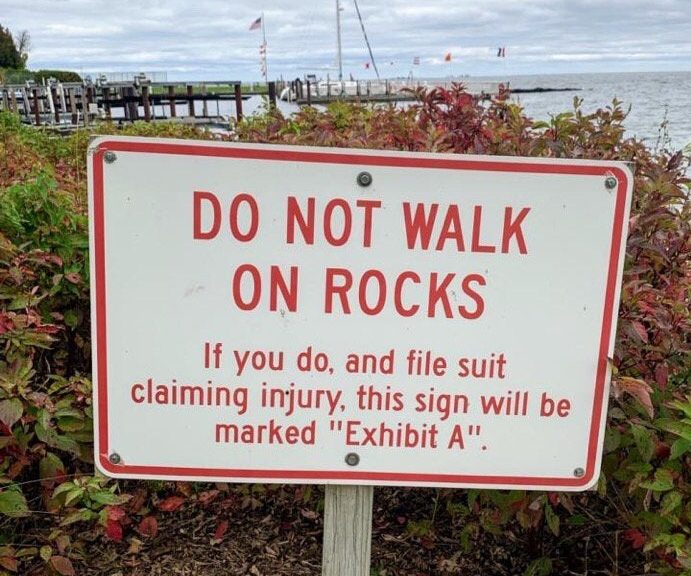
Insurance companies and defendants use assumption of the risk, a legal doctrine, to try to deny injury claims. The doctrine holds that if a person is aware of a dangerous condition, they should not ignore the risk. The above sign is a clear cut example: if you walk on the rocks and are injured, you cannot blame the landowner.

Most would agree we should be responsible for the consequences of voluntarily participating in activities we know are risky. But what happens when a landowner puts up a sign on their property saying: “be careful where you step because we are not responsible for any injuries.” If you are injured on the property, can the owner rely on its warning?

In Georgia, assumption of risk applies when the person injured (1) had actual knowledge of the danger; (2) understood and appreciated the risks associated with such danger; and (3) voluntarily exposed himself to those risks. Daly v. Berryhill, S19G0499 (2020).

How is this decided? While each case has unique facts, a court will look at whether the evidence shows the person knew of the specific risk of harm associated with the activity that caused injury, yet proceeded anyway. If there is a warning sign, like the one above, you are going to lose. If there was a general warning or no warning, but using common sense might have disclosed the risk, then it is a closer question.

An example would be someone who goes skiing assumes the risk they will fall and break a bone. If this happens, they cannot sue the ski resort for such an injury. On the other hand, if the ski resort failed to properly maintain a path down the mountain, but had warned that the path might be dangerous, then successfully suing the ski resort depends on whether the skier was aware of the particular risk.

If you have an injury case that involves negligence and assumption of the risk, please call us so we can explain your options.  

Getting Insurance to Pay When you Can’t Find the Negligent Driver

When suing a negligent driver for injuries, the general rule in Georgia is that the negligent driver must be personally served with the legal paperwork—this means a sheriff must hand deliver the legal paperwork to the negligent driver. This undisputedly insures that the negligent driver is aware of the lawsuit. But what happens when the negligent driver’s whereabouts are unknown? For instance, the negligent driver has moved or is intentionally avoiding service.

While this isn’t a common problem, it occurs from time to time. From a personal injury standpoint, this becomes a critical issue when the negligent driver has insurance coverage but can’t be found. Is the insurance company still on the hook to provide coverage?

If the negligent driver can’t be personally served, Georgia law allows what is called service by publication. This is when notice of the lawsuit is published in the local newspaper. This is permitted when the person resides outside the state, or has departed from the state, or can’t, after due diligence, be found within the state, or conceals himself or herself to avoid the service of the summons. This language is found in O.C.G.A. § 9-11-4(f)(1)(A).

Sounds easy enough, but, as mentioned above, the important question is whether service by publication is sufficient to hold the insurance company liable. Like most legal questions, it depends …

Henderson v. James, A19A0632 (June 6, 2019), a Georgia Court of Appeals decision, faced the exact question. In this case, which involved whether an insurance company could be held liable on behalf of a negligent driver who couldn’t be personally served. Even though the negligent driver had been service by publication, the Court of Appeals ruled in favor of the insurance company, holding that service by publication gives a court personal jurisdiction (i.e., allows a recovery against the insurance company) if, and only if, all of the following apply:

(1) The lawsuit must involve a tort (a wrongful act or an infringement of a right leading to civil legal liability). Because injuries from motor vehicle collisions are considered torts, this is not an issue in these cases.

(2) The negligent driver must be a resident in the county where the lawsuit is filed and must be present within the county.

(3) The negligent driver must have actual knowledge of the lawsuit and must be intentionally avoiding being served with the legal paperwork.

Only if the evidence shows that all three of the above standards have been met will the insurance company be responsible for providing coverage. In Henderson, the injured party lost because the evidence before the court didn’t establish the second or third standards.

A trick used by the insurance companies is to file a motion to dismiss on this issue two years after the collision. In Georgia, there is a two-year statute of limitation. If the negligent driver isn’t properly served within the two years, then most of the time the case is dismissed. Generally, there are no second chances after the two years has expired.

Getting personal service within two years after the motor vehicle collision is critical. Please call us if you are injured in a motor vehicle collision. We have over 20 years’ experience dealing with these types of issues.

Suing a Parent of an Adult Child Who Causes a Motor Vehicle Collision

In Georgia, what happens if you help your adult child by co-signing on a car note and by getting automobile insurance for your child, and your child causes a collision that injures another driver? This was the issue in a recent case decided by the Georgia Court of Appeals: Yim v. Carr, A19A0715 (April 23, 2019). In Yim, the Court decided in favor of the parents who had been sued by the driver injured by their child.

Generally, parents are liable for injuries caused by a child if the child was doing something for the parents or for the family at the time the incident occurred. This is called the “family purpose doctrine.”  To establish that a parent is responsible for their child, the following must be found present: (1) the owner of the vehicle (the parent) must have given permission to a family member to drive the vehicle; (2) the vehicle’s owner (the parent) must have relinquished control of the vehicle to the family member; (3) the family member must be in the vehicle; and (4) the vehicle must be engaged in a family purpose.

In Yim, although the vehicle was registered in parents’ name and driven by a family member, that wasn’t enough because the facts showed that the adult child had authority and control over the vehicle. Thus, title to the vehicle (which was in the parents’ names) or payment for the expenses of operation (which were being made by the parents) aren’t the deciding factors.

If you are injured by a minor driving their parents’ vehicle, please call us to discuss your options to make claims against both the driver and the parents.

Venue In An Uninsured Motorist Lawsuit

The Georgia Supreme Court has ruled that an uninsured motorist lawsuit against a known defendant and an unknown defendant can be brought in the county where the accident occurred. Carpenter v. McMann et al., S17G1894 (8/2/18).

The Georgia Constitution says, generally, that lawsuits must be filed in the county in which the responsible party resides. But, it also says that if there are two or more responsible parties who reside in different counties, the lawsuit can be filed in either of the defendants’ “home” counties.

In Carpenter, one of the (alleged) responsible parties left the scene of the collision and was therefore unknown. Lawyers and the courts label these unknown parties as “John or Jane Does.” Under Georgia uninsured motorist law, a lawsuit against a John or Jane Doe can be brought in the county where the collision occurred. What is a little unusual in Carpenter is there was one known defendant and one unknown defendant.

The question before the Georgia Supreme Court was whether the lawsuit should have been filed in the county where the known defendant resided instead of where the collision occurred. Reading the Georgia constitution and relevant statutory provisions together, the Court found that the plain language of drafted by the Georgia legislature permitted the injured party to choose the county where the collision occurred (via the unknown driver) and not the county where the known driver resided.

Holding a government employee responsible for injuries in Georgia: Ante litem notices


If you’re hurt by a police officer involved in a high-speed pursuit or county employee negligently driving a government truck, you must follow a complicated set of procedures to recover for your injuries. This is because the government and/or its employees are protected under the doctrine of sovereign immunity. Not closely following these procedures will cause you to quickly lose your claim on a technicality.

The blog deals with the very first requirement, which is sending an ante litem notice. An ante litem notice is a letter sent to the government entity that describes the details of the incident, explains why the government entity is responsible, and states the injuries sustained. In theory, an ante litem notice is required to give the government entity an opportunity to timely investigate the allegations. With few exceptions, failure to timely send an ante litem notice to the correct entity ends a claim for injuries.

Generally, claims vary by the type of government entity: for example, counties, cities/municipalities, state entities, or federal entities. Below is a quick overview of some basic aspects of ante litem notice requirements.

With respect to a county entity (for example, a county sheriff’s office), an ante litem notice must be presented within 12 months of the injury. Each county is set up a little differently, but generally notice should go to the county attorney and county board of commissioners. With respect to a city or municipality, an ante litem notice must be presented within six months of the injury. Notice is normally sent to the mayor and the city attorney. Ante litem notices to the State of Georgia must be presented within twelve months after the injury. The notice must be delivered to the Risk Management Division of the Department of Administrative Services as well as the government office that is the basis for the claim. Finally, claims against the Federal Government and/or its employees requires submitting a Form 95 administrative claim to the responsible federal agency within two years of the injury.

Even though in our 20 plus years of practicing law we’ve personally never known a government agency take any action in response to an ante litem notice, Georgia courts strictly apply these rules and they must be carefully followed.

Langley: Important New Personal Injury Case

Langley v. MP Spring Lake, LLC, A18A0193 (May 1, 2018), just issued by the Georgia Court of Appeals, may have a big impact on many future Georgia personal injury cases. Langley involves a residential landlord-tenant relationship in which a tenant sued her landlord for injuries more than a year after the injuries occurred. Normally, in Georgia, an injured party has two years to file a personal injury lawsuit. However, in this case, the landlord moved to dismiss the case because the lease provided only one year to sue the landlord.  This is the exact language in the lease:

Limitation on Actions. To the extent allowed by law, Resident also agrees and understands that any legal action against Management or Owner must be instituted within one year of the date any claim or cause of action arises and that any action filed after one year from such date shall be time barred as a matter of law.

Focusing on the word any, the Court of Appeals ruled that any legal action included not only breach of contract claims but also personal injury claims. Thus, the lease trumped Georgia’s statute of limitations. The Court reasoned that parties should be free to enter into contracts without interference from the courts.

At Gomez & Golomb, we practice personal injury and real estate litigation. Thus, for us, Langley cuts both ways. It’s bad for our personal injury clients, but good for our real estate and corporate clients. From now on, in personal injury cases, we will be looking even more closely at applicable contracts for language that may limit injury claims. For our real estate and corporate clients, we will be advising them that Langley opens the door to include terms in their contracts that limit liability.

Negligence law in Georgia

What is negligence law? At the risk of sounding overdramatic, at Gomez & Golomb LLC, we believe negligence law is similar to the golden rule, which is “do unto others as you would have them do unto you.” Here is why.

Long ago, the first laws developed to discourage citizens from intentionally harming each other. Under this system, when someone intentionally harms another, the state prosecutes the responsible person. If found guilty, the state puts the person in jail.

But what about when someone unintentionally harms another? Clearly, it would be unfair to put someone in jail for conduct that lacked intent, but, at the same time, it would also be unfair to the injured person if there were no consequences? As a middle ground, we created a set of rules known as negligence law in which a negligent party isn’t prosecuted or jailed for wrongdoing, but is liable for the monetary damages caused to the harmed party. In other words, as we go about our daily business in our communities, we are obligated to act in a manner consistent with that of an ordinarily prudent and reasonable person. Georgia law confirms this principle. See O.C.G.A. § 51-1-2.

The personal injury cases we handle at Gomez & Golomb LLC all involve negligence. This means the responsible parties harmed our clients but did so without any intent. Examples of cases we’ve worked on are drivers who didn’t pay close enough attention to the road, manufacturers who design products without attention to safety, or doctors who provide medical treatment that isn’t as good as it should be.  None of these parties woke up with up plans to harm to anyone, but, for various reasons, each acted in a way that a careful, responsible, and reasonable person would not.

In our view, our society is better off when someone who intentionally harms another is put in jail and someone who unintentionally harms another is responsible for paying for the damages. While not everyone agrees with this system, and there is no doubt abuse, the alternative is a society without incentive to treat each other as each of us would like to be treated (the golden rule).

At Gomez & Golomb LLC, we see our job as making sure our clients are fairly compensated for legitimate injuries sustained because another person or entity failed to act responsibly.