Venue in a Trucking Case

In a recent dispute over where a wrongful death lawsuit should be tried, the plaintiff made the winning argument against a commercial trucking company. Natasha Blakemore as Mother of Natroya Hulbert v. Dirt Movers, Inc. et al., A17A1540 (January 11, 2018). The plaintiff argued that the case should be tried in the county where the injury took place, while the trucking company argued it had the right to remove the case to the county where its office was located.

The two statutes at issue were O.C.G.A. §§ 40-1-117(b) and 14-2-510(b)(4). O.C.G.A. § 40-1-117(b) is part of the Georgia Motor Carrier Act, which are the statutes that govern commercial motor carriers. That statute says an injured party who sues a motor carrier can bring the case in the county where the injury occurred regardless of where the motor carrier is located. In contrast, O.C.G.A. § 14-2-510(b)(5), which governs corporations, says that, regardless of where the injuries occurred, a corporation is entitled to have the case adjudicated in the county where it maintains its principal place of business.

Here, Dirt Movers, Inc. argued that O.C.G.A. § 14-2-510(b)(5) should apply even if venue was proper under O.C.G.A. § 40-1-117(b). The Court of Appeals disagreed. Holding that if venue was proper under both O.C.G.A. §§ 40-1-117(b) and 14-2-510(b)(4), which was true here, the plaintiff was entitled to bring her lawsuit in the county where the injuries occurred.

Nice try by the trucking company, but the case will go forward in the county where the injuries occurred.

Medical Malpractice Affidavits

Sworn affidavit from another doctor required in Georgia

To make sure a lawsuit against a doctor has merit, an injured party must provide an affidavit from an impartial doctor (i.e., an expert doctor) confirming the alleged malpractice of the treating doctor.  Georgia courts have stated that the purpose of this requirement is to “reduce the number of frivolous malpractice suits being filed.” Oller v. Rockdale Hosp., A17A1208 (decided August 14, 2017). From an injured party’s perspective, meeting this requirement isn’t easy. First, getting a doctor to review a case is very expensive. Second, this process requires a doctor to stand in judgment of another doctor, which understandably isn’t something most doctors want to do.

If an expert doctor reviews the facts and medical records, and agrees to sign a malpractice affidavit, the story isn’t over. The affidavit has to be carefully drafted because the courts have dismissed a number of medical malpractice claims due to inadequate affidavits. To overcome a challenge to a medical malpractice affidavit, the expert doctor must allege the following:

  • that the treating doctor failed to satisfy the standard of care for doctors treating a patient under similar conditions and like surrounding circumstances; and
  • that the expert doctor has knowledge and experience in the practice or speciality that is relevant to the acts or omissions alleged against the treating doctor (importantly, a medical doctor does not have to practice in same specialty as defendant medical doctor to be qualified to submit expert affidavit).

Meeting these requirements is a prerequisite for filing a valid lawsuit against a doctor and is a critical part of recovering damages against a doctor in Georgia. Please call us for a free consultation if you been injured due to the negligence of a doctor–we’ll be happy to review your options and discuss how we can help get your claim resolved.

Gomez & Golomb LLC Resolves Traumatic Brain Injury Case Against Textron d/b/a E-Z-GO

Confidential Settlement with Textron, Inc. d/b/a E-Z-GO

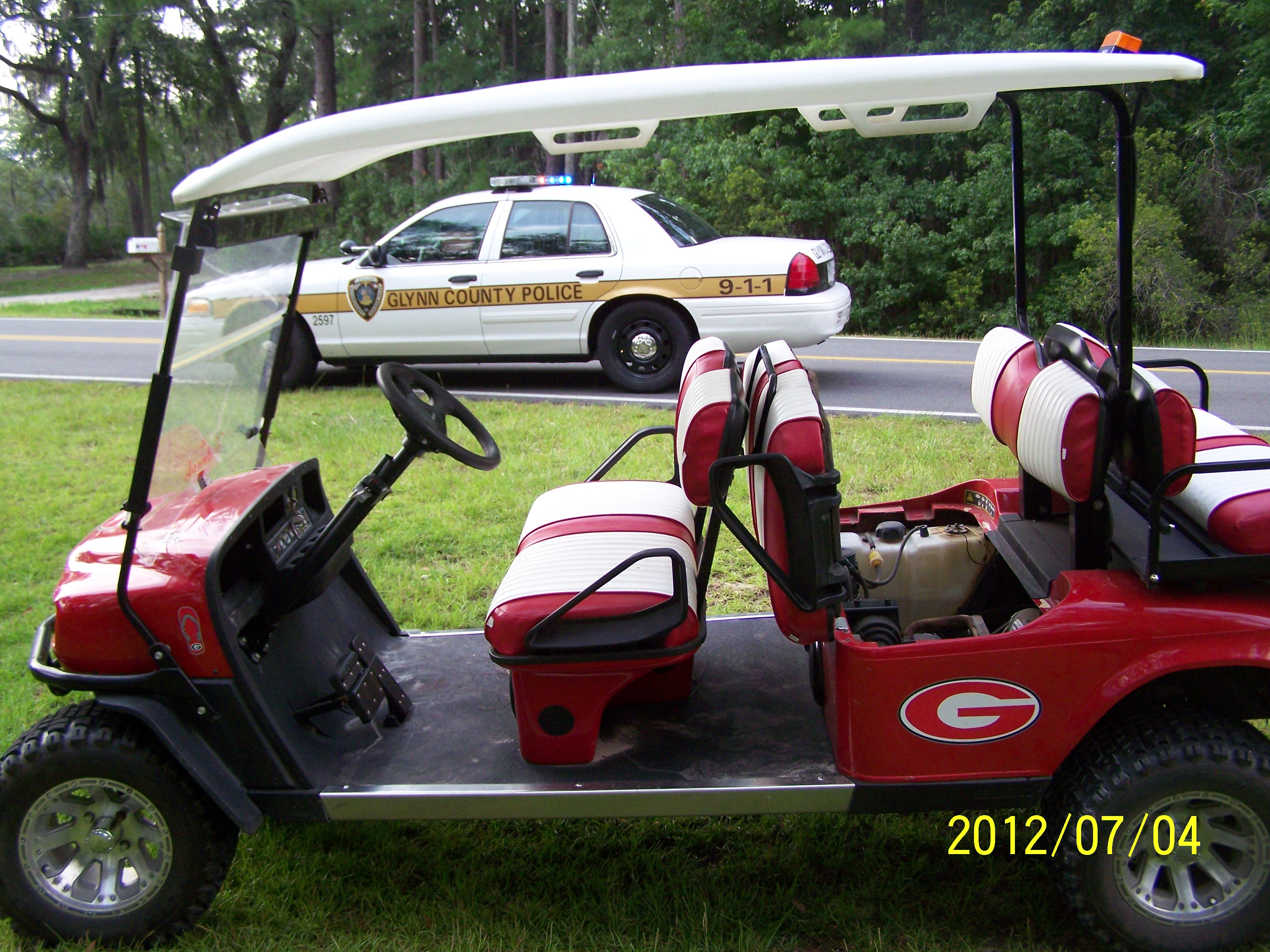
We represent a young man ejected from a golf cart (more accurately a personal transportation vehicle) resulting from a sharp left-hand turn. The photo above is the cart immediately after the incident. This happened in 2012. The ejectment threw the young man head first onto a paved road. The young man spent many months in the hospital with his family. He is a fighter and made a miraculous recovery (he had to relearn how to walk, talk, and eat). Despite his recovery, because of the severity of the impact to his head, he left the hospital with permanent traumatic brain injury (T.B.I.). This is an injury that rarely improves, and, unfortunately, is permanent. Needless to say, brain function is critical to every aspect of life, and this was a devastating injury to our client and his family. 

After hiring experts to investigate the cart and the circumstances of the incident, we determined that the manufacturer of the personal transportation vehicle, Textron, Inc. d/b/a E-Z-GO, had been warned by and well-known engineer in 2007 about passengers being ejected from these types of vehicles because of inadequate passenger-side hip restraints. This engineer was particularly concerned with the rise in injuries to children between the ages of 12-16. Textron, Inc. d/b/a E-Z-GO were also aware of a 2006 peer-reviewed journal article raising these same concerns.

From 2007 until 2012, Textron, Inc. d/b/a E-Z-GO had more than 10 meeting with the engineer who issued the warning, yet failed to make any safety changes to the passenger hip restraint, failed to issue any warnings to existing customers, and failed to recall any of the unsafe vehicles already on the road.

After getting no response from Textron, Inc. d/b/a E-Z-GO, we filed a lawsuit in Fulton County State Court. Textron, Inc. d/b/a E-Z-GO hired a large silk-stocking Atlanta law firm to vigorously defend the case. Textron, Inc. d/b/a E-Z-GO’s main claims were that these vehicles weren’t supposed to be driven on public roads. As the risk of sounding glib, Textron, Inc. d/b/a E-Z-GO’s argument that these vehicles shouldn’t be used on public roads was laughable. Textron, Inc. d/b/a E-Z-GO took the position that because there was a warning on the cart against driving on a public road, then E-Z-GO was responsible for injures on public roads, even if there vehicles were unsafe.

Below is an example of some of the marketing material from E-Z-GO’s website and twitter pages that we were ready to show the jury at trial. This evidence shows that EZGO continuously and aggressively marketed these vehicles to families with children to use in and around their neighborhoods. In fact, anyone that’s lived in a suburban neighborhood has seen families and teenagers using these vehicles to get around on neighborhood roads.

During the next several years, we argued summary judgment motions, Daubert motions, discovery dispute motions, and took depositions of experts in Connecticut, Minnesota, Georgia, and Florida. After almost five years of non-stop work, this past Monday, we finally started a jury trial that was expected to last about 10 days.

In total, close to 30 witnesses were expected to testify.Our side had testimony from two engineers and five doctors, while Textron d/b/a E-Z-GO had testimony from two engineers and a human factors expert.On Monday, we spent all day picking a jury. While we were pleased with the jurors selected, and hopeful both sides would get a fair and impartial judgment based on the evidence presented. Opening arguments took place Tuesday morning until lunch, with each side making compelling arguments for their clients. However, during lunch, the opposing sides approached each other, now having heard each other’s full arguments, to explore settlement. After some deliberation, the case settled for a confidential amount. Although we prepared and hoped to take the case to conclusion, our client was very happy with the result and the settlement was truly in his best interest. 

To be clear, we have not and will never advocate against the use of these types of vehicles. They serve an important function in many communities and are flat out fun. However, our profound hope is that Textron d/b/a E-Z-GO will carefully examine the passenger restraint systems on all its vehicles, current and past, and that it will commit itself to designing and manufacturing safe golf carts and passenger vehicles for typical use, which is often by teenagers on public, neighborhood roads. We also implore Textron d/b/a E-Z-GO to consider recalling any unsafe vehicles currently on the roads with unsafe passenger restraint systems.

Click here to see to an article from Courtroom View Network summarizing the case.

Recover punitive damages in Georgia (even without injuries)

Punitive Damages: Generally

If you’re involved in an car wreck and the conduct of the party who caused the collision was reckless and intentional, you may be entitled to punitive damages. The two most common examples of misconduct that warrant punitive damages are hit and run and drunk driving. Also, whether the offending party has a history of reckless driving is an important factor. The purpose of of punitive damages isn’t to make the injured party whole, but rather to send a forceful message to the offending party and the public that reckless driving won’t be tolerated. Probably everyone can agree that limiting reckless driving is a worthwhile undertaking.

O.C.G.A. § 51-12-5.1(b) provides that “[p]unitive damages may be awarded in such actions in which it is proven by clear and convincing evidence that the defendant’s actions showed willful misconduct, malice, fraud, wantonness, oppression, or that entire want of care which would raise the presumption of conscious indifference to consequences.”  O.C.G.A. § 51-12-5.1(c) further states that punitive damages “shall be awarded not as compensation to a plaintiff but solely to punish, penalize, or deter a defendant.”

Leaving the scene and driving under the influence are examples of of wilful misconduct, wantonness, and that want of care that shows conscious indifference to the consequences. According to O.C.G.A. § 51-12-5.1(f), in these situations, a jury is entitled to award the injured party unlimited punitive damages:

In a tort case in which the cause of action does not arise from product liability, if it is found that the defendant acted, or failed to act, with the specific intent to cause harm . . . there shall be no limitation regarding the amount which may be awarded as punitive damages . . .”

Punitive Damages: Property Damage Claims

In Georgia, punitive damages are recoverable in a property damage claim even if there are no injuries. Bowen v. Waters, 170 Ga. App. 65 (1984), aff’d, 175 Ga. App. 884 (1985) (“While an award of punitive damages is authorized only where a tortfeasor’s conduct is of an aggravated nature, such an award may properly be based upon an aggravated tort involving only property rights.”).

At Gomez & Golomb, unlike some others, we’re not a cookie cutter personal injury law firm. We devote our full attention to each case so that we maximize your recovery. If you’re in a collision, please call us to discuss whether your case is the type that might justify punitive damages, and what other damages you might be entitled to.

Serving a Lawsuit in Georgia: Understanding the Sheriff’s Entry of Service Form

In Georgia, with some exceptions, the opposing party a/k/a the defendant must be “personally” served before a lawsuit can go forward. This means the lawsuit must be physically handed to the defendant. If the defendant is a corporation, service is made on the corporation’s registered agent. (Every corporation in Georgia is required to appoint a registered agent—this information can be found on the Georgia Secretary of State’s website.)

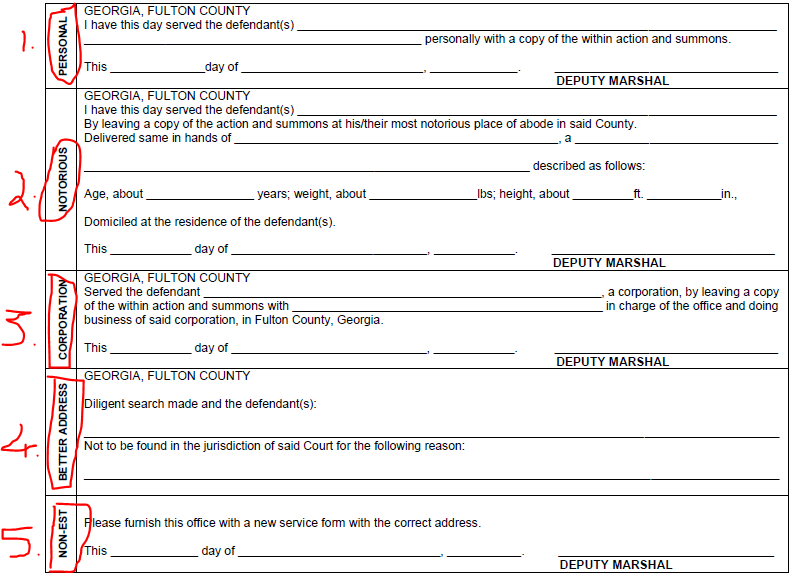
Service usually begins by providing the sheriff a copy of the complaint, summons, and sheriff’s entry of service form. Service by the sheriff typically takes two to three weeks, during which time a sheriff’s deputy will complete the form and mail it back to the filing party. What does this form mean? Below is the relevant part of the form and how we address the various types of service in our office:

If the “personal” box is completed (box # 1 above), almost always, the sheriff has handed the paperwork to the opposing party and service is complete. Now we can get to work on the case.

If the “notorious” box is checked (box # 2 above)  this means the sheriff has handed the paperwork to someone over 18 years old who lives the opposing party. Georgia law allows notorious service, but, in our experience, we should be cautious in these situations because notorious service is sometimes unreliable and can challenged. Fortunately, an answer is due from the opposing party 30 days after service. If service isn’t contested in the answer, we no longer need to worry about service. If service is contested in the answer and seems reasonable, we will discuss with you the merits of repeating service. Ultimately, getting proper service is important because if we don’t have proper service, any judgment we obtain might be overturned.

The “corporation” box  (box # 3 above) obviously applies to serving a corporation. If this is checked, generally, this ends up being successful service.

If the “better address” box is checked (box # 5 above)  this means the person living at the address provided has told the sheriff that opposing party has moved.

Finally, the dreaded “non-est” box  box # 5 above): this means the sheriff has gone to the address provided but was unable to serve the defendant. Most importantly, this means the lawsuit can’t continue. At this point, we need to determine if we have a good address for the opposing party. A defendant can be served at home, work, church, etc. If we are confident we have a good address despite the sheriff being unsuccessful, we recommend hiring a private process server. Unlike the sheriff, a private process server will work with us and has a much better chance of successfully serving the defendant. The cost for a private process server is about $100, but goes up depending on difficulty. If we aren’t confident that we have a good address, we recommend hiring an investigator to find a good address for the defendant. This is more expensive and will cost $250 and upwards.

If we still can’t find the defendant or believe the defendant is avoiding service, we’re entitled to ask the court to allow us to serve the opposing party by publication. We’ll address service by publication in a separate blog.

We hope this gives you a better idea regarding service of a lawsuit in Georgia. If you have any questions, please don’t hesitate to call us at 404-382-9994.

Slip and Fall Personal Injuries Part Three

Current Law

In 2009, American Multi-Cinema, Inc. et al. v. Brown et al., the Supreme Court reaffirmed Robinson. Taking note of Robinson’s admonition that “routine” issues of premises liability are not subject to summary adjudication unless plain, palpable, and undisputed evidenced shows otherwise,” the Court affirmed the lower court’s finding that the trial court erred in granting summary judgment to the defendant. 285 Ga. 442, 445, 448.

The decision whether to recognize the [invitees] theory of recovery as valid under Georgia premises liability law is precisely the type of legal policy judgment we instructed in Robinson must be left to a jury to decide in light of all the attendant circumstances. It is one of the ‘routine’ issues of premises liability—’the negligence of the defendant’—that is “generally not susceptible of summary adjudication” unless the “plain, palpable, and undisputed” evidence requires otherwise. (citations omitted). At 446.

A hazard has been defined as “[a] danger or risk lurking in a situation which by chance or fortuity develops into an active agency of harm.” Gresham v. Bell’s Food Mkt, 244 Ga. App. 240, 241 (2000) (quoting Black’s Law Dictionary). Either actual or constructive knowledge of the hazard by a defendant will satisfy the first prong. Robinson, at 748. Here, there is both. Defendant admits traversing the stairway, including on the date in question. Defendant therefore has actual knowledge of the alleged hazard.

In analyzing an injured party’s knowledge of a hazard, “Robinson reminded all courts that the plaintiff’s lack of ordinary care for personal safety is generally not susceptible of summary adjudication and that only when the evidence is plain, palpable, and undisputed is summary judgment authorized.” Mac Intern.-Savannah Hotel, Inc. v. Hallman, 265 Ga. App. 727 (2004) (referencing Robinson at 748).

This quick three-part series on Georgia slip and fall law is just the tip of the iceberg. Please call us to discuss your specific situation.

Slip and Fall Personal Injuries Part Two

Robinson v. Kroger: Surviving Summary Judgment

Following up on our previous blog, the Georgia Supreme Court in 1997 changed the slip and fall landscape. The Court ruled that “an [injured party’s] failure to exercise ordinary care for personal safety is not established as a matter of law by the [injured party’s] admission that she did not look at the site on which she subsequently placed her foot”).

After Robinson, an injured party need only prove (1) that the landowner had actual or constructive knowledge of the hazard, and (2) that the injured party lacked knowledge of the hazard despite the exercise of ordinary care due to actions or conditions within the control of the owner.

Robinson is important because it shifts the focus from the injured party’s conduct to the landowner’s conduct. After Robinson, if the injured party shows the landowner knew about the hazard, then the burden shifts to the landowner to show the injury was caused by the injured party’s negligence (intentional disregard of a known risk or failure to exercise ordinary care for one’s personal safety). This makes it much easier for injured parties to survive summary judgment and get their cases in front of a jury.

Robinson remains good law today.

Slip and Fall Personal Injuries Part One

Previous Georgia Law

Under Georgia law, a landowner has a nondelegable statutory duty to keep its premises and approaches safe for a customer or guest (lawyers refer to such persons as “invitees”). OCGA § 51-3-1. Georgia law states: “Where an owner or occupier of land, by express or implied invitation, induces or leads others to come upon his premises for any lawful purpose, he is liable in damages to such persons for injuries caused by his failure to exercise ordinary care in keeping the premises and approaches safe.”

Analysis of Georgia premises liability law begins with Alterman Foods v. Ligon, 240 Ga. 620 (1980). Alterman Foods established a two-prong test. To recover, injured parties had to show (1) the landowner had actual or constructive knowledge of hazard, and (2) the injured party was without knowledge of the hazard (or for some reason attributable to landowner was prevented from discovering the hazard). After Alterman and for the next 17 years, the conduct of the injured party was the focus. Few slip and fall cases injury cases survived summary judgment. A summary judgment is when a court rules as a matter of law for the landowner; this means the judge and not a jury decides the case.

Recognizing that the pendulum had swung too far in favor of landowners, the Georgia Supreme Court, in Robinson v. Kroger, found that “routine issues of premises liability, i.e., negligence, and the plaintiff’s lack of ordinary care for personal safety[,] are generally not susceptible of summary adjudication.” 268 Ga. 735,748 (1997) (“an invitee’s failure to exercise ordinary care for personal safety is not established as a matter of law by the invitee’s admission that she did not look at the site on which she subsequently placed her foot”).

In part two, we will discuss current current slip and fall law in Georgia.

Rape and Assault Cases in Georgia

Criminal Attacks are Happening More Frequently and Many Perpetrators Are Not Prosecuted or Go to Jail

In 2011, U.S. residents age 12 or older experienced an estimated 5.8 million violent criminal attacks, according to a report released by the Justice Department’s Bureau of Justice Statistics. These estimates are based on data from the annual National Crime Victimization Survey. Even worse, many of these criminals committing rape and assault do not go to jail. In fact, out of 1,000 sexual assaults, 975 perpetrators will walk free. And out of 1000 assault and battery crimes, 959 will never be charged with a felony. 

Criminal Attacks are Preventable

Rape and assault attacks often occur at apartment complexes, restaurants, hotels, and other businesses. These businesses, which invite you onto their property and profit accordingly, have a legal responsibility to provide a safe environment for their customers. And a responsibility to prevent crimes that are predictable. 

Inadequate Security

Many crimes result from business owners providing inadequate security for their customers. In these situations, a crime victim has a civil claim for damages against the business.

To establish liability in Georgia for inadequate security against a business, an injured party must show that the business owner has breached a duty “to exercise ordinary care in keeping the premises and approaches safe.”

Concerning criminal attacks, the business owner’s duty extends only to foreseeable criminal acts. In Sturbridge Partners v. Walker, 267 Ga. 785 (1997), the Supreme Court of Georgia “laid to rest the artificial notion that a crime against a person could never be foreseen by previous crimes against property” and, instead, provided more flexible guidelines for determining whether a crime is foreseeable. A crime is foreseeable if there have been similar prior crimes and the business owner has failed to act to prevent such crimes. 

Prior Criminal Attacks

To determine whether previous criminal acts are similar, the court must inquire into the location, nature, and extent of the prior criminal activities. While the prior criminal activity must be substantially similar to the particular crime in question, that does not mean identical. What is required is that the prior crime is sufficient to attract the business owner’s attention to crime. 

For example, are two previous burglaries enough to create the foreseeability of a rape at an apartment complex? Sturbridge concluded that the previous burglaries did create foreseeability because, although the burglaries “were committed when the apartments were vacant, it was reasonable to anticipate that an unauthorized entry might occur while an apartment was occupied and personal harm to a tenant could result.”

Rape and Assault Resources

If you are the victim of rape or assault, you are not alone. Here are some links to organizations that will help you free of cost. This is not something you want to go through without help–so please call!!!

http://www.safehorizon.org/index.php

http://www.summitadvocates.org/

http://www.callforhelpinc.org/

http://www.victimsofcrime.org/home

Georgia Crime Victims Compensation: See post.

Call Us!

In rape and assault cases in Atlanta and Georgia, it is critical to obtain records from all prior crimes that occurred where the crime occurred. At Gomez & Golomb LLC, we have been handling these cases for over 20 years. Please call 404-382-9994 to speak with an attorney.

Negligent Probation Supervision: Guidance from Peterson v. Reeves, 315 Ga.App. 370 (2012)

We are currently involved in a wrongful death case against a Georgia private probation company for negligent probation supervision. The probation company knew our client was a severe alcoholic, a type-1 diabetic, and had three DUI convictions. Despite this and contrary to the court’s order and Georgia law, the probation company failed to reasonably monitor our client for alcohol consumption. For example, our client violated court-ordered home alcohol monitoring testing 183 times, but this was never reported to the court. The probation company’s lenient supervision gave our client the opportunity to drink heavily for weeks on end, ultimately resulting in her death from a diabetic coma.

There are no Georgia appellate decisions directly on point. But, there is a similar case, at least with respect to claims for professional negligence. Peterson v. Reeves, 315 Ga.App. 370 (2012). In Peterson, a plaintiff sued her psychiatrist for failing to prevent injuries sustained when she attempted suicide. The psychiatrist moved for summary judgment, arguing he had no duty to involuntarily commit Plaintiff, who at the time of the suicide attempt was in an outpatient mental health care. The trial court denied the psychiatrist’s summary judgment motion. Judge McFadden, writing for the Georgia Court of Appeals, agreed with the trial court, finding that

whether [the psychiatrist] breached duties arising from the psychiatrist-patient relationship is an issue of fact . . . [t]he evidence would authorize a jury to find that [the psychiatrist] shares in the responsibility for a negligent failure to subject [the plaintiff] to a suicide or self-injury risk assessment, and adequate psychiatric evaluation, and consideration for hospitalization; that he shares in responsibility for the failure to stabilize [the plaintiff]; and that he was negligent in failing to be available for consultation, or to have another psychiatrist available . . . [a]nd the evidence would authorize a jury to find that those negligent omissions were a proximate cause of the defendant’s lack of control  over [the plaintiff] at the time of her attempted suicide as well as of the attempted suicide as well.

The underlying facts show that the psychiatrist was aware of plaintiff’s history of severe mental illness and high risk to attempt suicide, but, nonetheless, he allowed her to be discharged from a mental hospital without being subjected to a suicide assessment or considered for involuntary hospitalization. Two days later, plaintiff poured gasoline over herself and set herself on fire.

The psychiatrist argued that he was not liable because he never had control over the plaintiff. The court disagreed, finding that “control over the plaintiff” is not relevant because the psychiatrist had a duty to provide a minimum level of medical care to the plaintiff. The appellate court ruled that whether the psychiatrist’s care of the patient fell below that minimum level is up to a jury to decide.

The psychiatrist also argued that even if he has a duty, that duty does not include taking affirmative action to protect a patient. Again the court rejected that argument, finding the duty at issue is not strictly a duty to involuntarily commit the patient, but, rather, is “a duty to exercise the applicable degree of care and skill in the treatment” of the patient.

The take home is that in a doctor-patient or in a probation officer-probationee relationships, the doctor or probation officer have a duty to do their job with a minimum level of competency. What the minimum level of competency varies from situation to situation, and is a question to be resolved by a jury.