
To establish an easement by prescription, the party making such a claim has the burden of proof. The elements of prescription are (1) possession that is in the right of the party claiming possession and not another, (2) possession that is public, continuous, exclusive, uninterrupted and peaceable, and (3) possession accompanied by a claim of right. OCGA § 44-5-161. Possession of property in conformance with these elements for 20 years confers good title by prescription to the property. OCGA § 44-5-163.
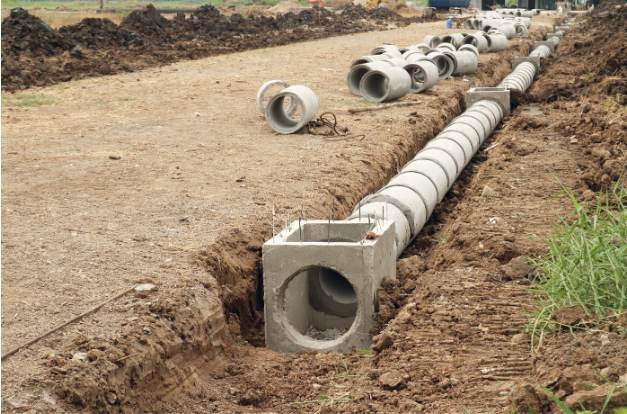
In a recent case, Talboy v. Dukes (__ Ga. App. __, October 4, 2023; A23A1068), the Georgia Court of Appeals examined the definition of “public” possession. The dispute in question revolved around an underground sewer line that extended into an adjacent property. The Court determined that the party seeking an easement could not establish public possession since the sewer line was underground and therefore not visible to the public.
In order to determine the meaning of “public“, the Court looked up its definition in the dictionary. According to Black’s Law Dictionary, the term “public” encompasses the definition of “notorious”. “Notorious possession” is defined as a type of possession that is so visible that it is generally known and discussed by the public or people in the surrounding area. Possession or the act of holding something that has such noticeable features that the owner may be presumed to have knowledge of it and its scope. This definition was taken from the 6th edition of Black’s Law Dictionary, published in 1990.
Applying this definition to adverse possession, the Court reasoned that the claimant could not show that the property was “so conspicuous that it is generally known and talked of by the public or the people in the neighborhood” or had “such elements of notoriety that [the Claimant] may be presumed to have notice of it and of its extent.”
The law regarding obtaining title to land by adverse possession can be abstract and confusing, but Talboy provides clarity regarding how to apply the requirement of public possession in the real world. Please call us at 404-382-9991 to discuss any questions you have about an easement or adverse possession.